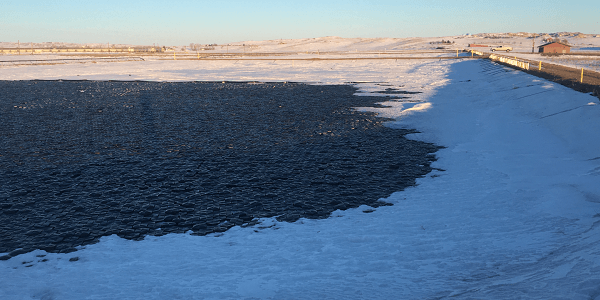
Heated Pond Heat Loss & Floating Cover ROI Calculator
Compare operating costs across No Cover, Solid Cover, and AWTT Modular Cover scenarios — using a five-component ASHRAE heat-loss model with real weather data.
For heated industrial ponds — biogas digesters, anaerobic lagoons, warm-process aquaculture, heated wastewater treatment cells — surface heat loss is the largest single operating cost. The AWTT Heat Loss & ROI Calculator models heat loss using a five-component ASHRAE pond model (evaporative, convective, radiative, ground conduction, solar gain) computed from real weather data and pond geometry. It then compares operating cost across three cover scenarios: No Cover, Solid Cover (geomembrane), and AWTT Modular Cover — across heating, chemicals, pumping, and makeup water.
Three heat-loss methods are available: Bill Mode (calibrates to your actual energy bill and uses a physics-based surface/ground split to allocate cover savings); ASHRAE Mode (full five-component model from weather and pond parameters); and BGG Mode (Brady-Graves-Geyer equilibrium temperature model for assessing whether the pond can stay warm without supplemental heating). Results display in monthly or annual timeframes, with a side-by-side three-way scenario comparison and a payback period for AWTT cover capital. Where open-water evaporation is the dominant concern rather than heating, run the companion evaporation rate calculator on the same pond.
ROI & Cost Savings Calculator
Compare operating costs — No Cover vs. Solid Cover vs. AWTT Modular Floating Cover
Calculator Mode
1 Global Parameters
Pond Size & Dimensions
Default: 5 ft if blank
2 Heating Costs
Electric resistance uses the Electricity Cost from Section 1.
Combustion efficiency (typ. 80–95%).
12 = year-round; 6 = half-year seasonal pool.
24 = continuous; 12 = single shift.
Dynamic flow-through: Water enters at the inlet temperature and flows through the pond continuously. The calculator predicts the steady-state pond and outlet temperature with each cover. Optionally, enable "Maintain a minimum outlet temperature" below to size a heater for each cover and see the heating-cost difference between insulation options.
Mixing model is auto-selected from pond geometry: plug-flow (Edinger / Brady-Graves-Geyer) for long ponds, well-mixed (CSTR) for shorter ponds and tanks.
Use your energy bill, or select a thermal model to calculate from weather & pond parameters.
Heated flow-through: Water enters at inlet temperature, is heated to the target discharge temperature, and exits the pond. The model calculates surface heat losses + flow heating energy for each cover scenario.
For round/short ponds (CSTR) these are identical. For long plug-flow ponds they differ.
If the natural temperature already meets this minimum for a cover, no heater is sized for that cover.
Fetches current air temperature, humidity, and wind speed for the ASHRAE calculation.
Fetching weather data…
The temperature your pond needs to maintain for discharge.
Temperature of water entering the pond. Required for flow-through mode.
Daily volume of water flowing through the pond. Required for flow-through mode.
Power-law profile to pond surface (≈0.5 m). ASHRAE Fundamentals Ch. 24.
▸ Advanced ASHRAE Parameters
24-hour average (W/m²). Auto-calculated from weather data. Override to customize.
Soil temp at pond depth. Default: depth-adjusted estimate (Kasuda model) if blank.
Hours per year the pond needs heating. Default 8766 (year-round).
Hottel beam (DNI × cos θ_z). Blank → 50% of single solar.
Liu-Jordan diffuse. Blank → 50% of single solar.
Average horizon mask. Use for ponds shaded by walls / forests.
If you know your current energy bill, enter it here. The model will use this as the no-cover baseline and scale the covered scenarios by the physics-based reduction ratios.
Insulation slows heat loss — compared to bare water surface (R-0.5 baseline)
3 Chemical Treatment
Covers block UV light — reducing algaecide & chemical dosing by 60%
4 Pumping & Aeration
Biofouling increases pump load — covers eliminate algae and restore clean-water efficiency
5 Water Makeup
Combined supply + sewer/discharge cost. Leave blank to skip makeup calc.
Evaporation losses must be replaced. Solid covers eliminate evaporation; AWTT cuts it by ~98%.
Related calculators
Surface Area Calculator
Rectangular, round, or frustum-shaped ponds and tanks with multi-pond totals and a 3D cover preview.
Evaporation Rate Calculator
Five FAO-56 / Harbeck methods, real-time weather, monthly chart, and a 5-tier Value Stack ROI overlay.
Specification Builder
Generate a CSI 3-part floating cover specification section with product selection, piece count, and an indicative budget band.
The Problem — Why It Matters
Facility operators and engineers face these measurable challenges that AWTT floating covers directly address.
Heated Pond Operators Don't Know Where Heat Actually Goes
For typical heated industrial ponds, evaporation accounts for 50–70% of total surface heat loss, convection 15–25%, radiation 10–20%, and ground conduction the rest. Operators often size cover ROI against the wrong loss component — overestimating insulation value and underestimating evaporation suppression value.
Energy Bills Don't Break Out Pond Heating
Facility utility bills aggregate pond heating with HVAC, lighting, and process equipment. Without a defensible heat-loss model, finance teams cannot allocate pond heating to a cost center — and capital requests for cover systems lack the per-pond ROI required for approval.
Solid Covers Trade Heating Savings for Maintenance Costs
Geomembrane solid covers eliminate evaporation but require condensate management, anchorage repair, and material replacement at 10–15 year intervals. Total cost of ownership comparisons that ignore these line items overstate solid-cover ROI by 30–50%.
Algae Biofouling Doubles Pump Energy
In open ponds with biological growth, biofouling on intake screens and pumps increases pumping energy by 10–37% over a clean-water baseline. The chemical addition to suppress algae itself costs $5,000–$50,000/yr at typical industrial scale — and floating covers eliminate both costs by blocking UV at the surface.
Flow-Through Heating Adds a Hidden Cost
For ponds with continuous makeup water flow (cooling water, process water blowdown, treated effluent), heating the incoming flow from inlet temperature to setpoint is a major energy cost — often larger than surface heat loss itself. Many cover-ROI analyses miss this entirely.
Lifecycle Cost vs Year-One Capital Confuse the Decision
A solid cover may be 30% cheaper to install but 2× more expensive over 20 years once condensate, repair, and replacement costs are included. A modular AWTT cover may have higher installed cost but lowest 20-year TCO. Without a lifecycle model, the capital approval committee picks the wrong cover.
The AWTT Solution
Modular, maintenance-free floating covers engineered to directly solve heat loss challenges in industrial liquid containment.
Five-Component ASHRAE Pond Heat-Loss Model
The calculator implements the full ASHRAE pond heat-loss model: evaporative (latent), convective (sensible via Bowen ratio), radiative (longwave to sky), ground conduction (Kasuda soil-temperature model), and solar gain. Each component is computed from real weather data plus pond geometry — and the cover R-value is applied to surface losses only (matching real cover physics, not assumed bulk insulation).
Three Heat-Loss Methods
Bill Mode calibrates physics to your actual energy bill using a dynamic surface/ground split (surface flux is 5.6× faster per unit area than ground conduction). ASHRAE Mode computes from weather and pond parameters. BGG Mode (Brady-Graves-Geyer) computes the equilibrium temperature a pond would reach without supplemental heating — answering "can I shut off the heater?"
Three-Way Scenario Comparison
Every result panel shows No Cover, Solid Cover (geomembrane), and AWTT Modular Cover side-by-side. You see the heating cost, chemical cost, pumping cost, makeup-water cost, and total operating cost for each scenario — at monthly or annual timeframes.
Payback Period and Lifecycle TCO
The calculator computes simple payback for the AWTT cover capital cost — and lifecycle 10-year and 20-year TCO including chemical savings, pumping savings, makeup water savings, and solid-cover maintenance line items ($0.025/ft²/yr typical). Use the payback to anchor capex approval; use the lifecycle to defend the cover-type selection.
Real Weather Data per Site
Enter location for ASHRAE mode and the calculator pulls current temperature, humidity, wind speed, daylight, and cloud cover from a nearby weather station. Solar irradiance is auto-computed from daylight + cloud cover (override available). Ground temperature defaults to a Kasuda depth-adjusted estimate.
Operational Realism Built In
Fuel type (electric resistance, heat pump, natural gas, propane, fuel oil, district heating), heating efficiency, operating hours per day, heating season months, wind exposure (open / suburban / wooded), and algae level (clear → severe) all feed the model — so a refinery cooling pond and a biogas digester both get site-appropriate results.
Technical Specifications — Heat Loss
Recommended Products
AWTT engineers recommend these floating cover systems for applications related to heat loss.
R-17 closed-cell foam | Heated ponds
Hexprotect® MAX R
AWTT's highest-R floating cover. Closed-cell foam core delivers R-17 thermal performance — the strongest single-product choice for digesters, heated industrial process water, and warm-climate aquaculture where heating energy dominates operating cost.
Learn more →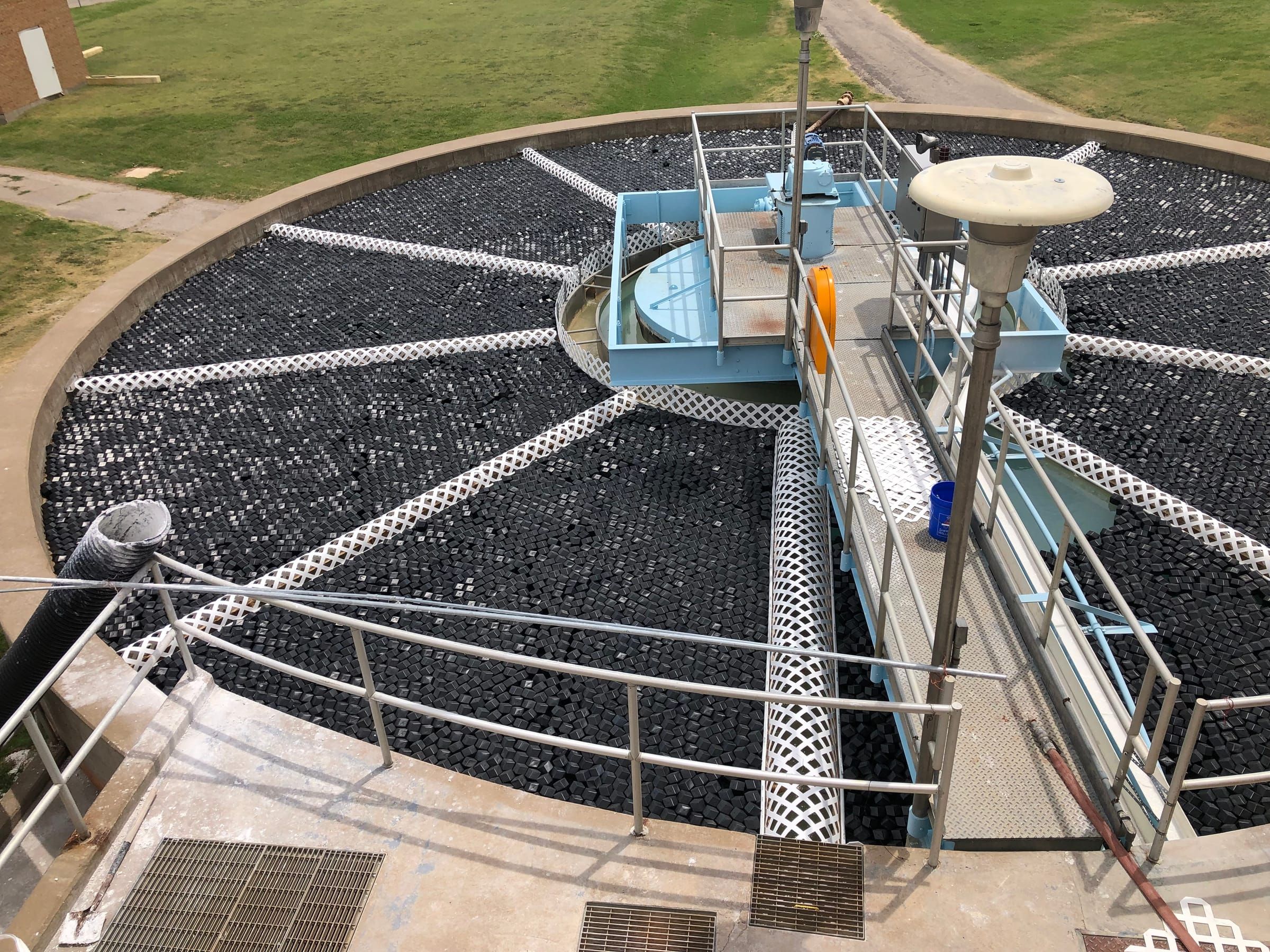
R-8 | Insulated rhombic hybrid
Rhombo Hexoshield® 189
Mid-range insulation with maximum evaporation reduction. For heated process ponds where evaporative cooling is the dominant heat-loss mechanism, the R-8 insulation plus 98% evaporation reduction delivers strongest combined savings.
Learn more → R-4 | Hybrid floating cover
Rhombo Hexoshield®
Cost-optimized choice for moderate-heat applications. R-4 thermal performance plus 98% evaporation reduction delivers the best dollars-per-BTU-saved across the AWTT range for ponds with shorter heating seasons.
Learn more →Frequently Asked Questions — Heat Loss
Common questions from engineers and operators using this calculator.
What is the difference between Bill, ASHRAE, and BGG modes?
How accurate is the ASHRAE model?
What is the Brady-Graves-Geyer equilibrium temperature?
Why does the calculator split heat loss between surface and ground?
What lifecycle cost is included in the TCO comparison?
How is solar gain handled?
Can I use the calculator for unheated ponds?
What is Dynamic flow-through mode and when should I use it?
Related Engineering Calculators
Other free AWTT engineering calculators for sizing floating covers, quantifying water loss, and projecting ROI.
Surface Area Calculator
Pond and tank surface area for rectangular and round shapes, frustum geometry, multi-pond totals, and a 3D cover preview.
Open calculator →Evaporation Rate Calculator
Live-weather pond evaporation with 5 physical models (Penman-Monteith, Priestley-Taylor, Hargreaves-Samani, aerodynamic, empirical) and per-product cover savings.
Open calculator →Ready to Talk with an AWTT Engineer?
Contact AWTT for a custom floating cover recommendation — including site assessment, specification sheets, and ROI analysis.
Engineering Tools & Resources
Evaporation Rate Calculator
Estimate evaporation losses on your pond or reservoir and the ROI of a floating cover, using five FAO-56 / Harbeck methods with real-time weather.
Heat Loss & ROI Calculator
Model heat loss from a heated pond with the ASHRAE 5-component balance, then compare insulation savings and 20-year cost of ownership.
Not Sure Which Cover?
Answer a few questions about your site conditions and get a personalized product recommendation.
Technical Specifications
View full engineering specs, wind resistance data, R-values, and material compliance details.