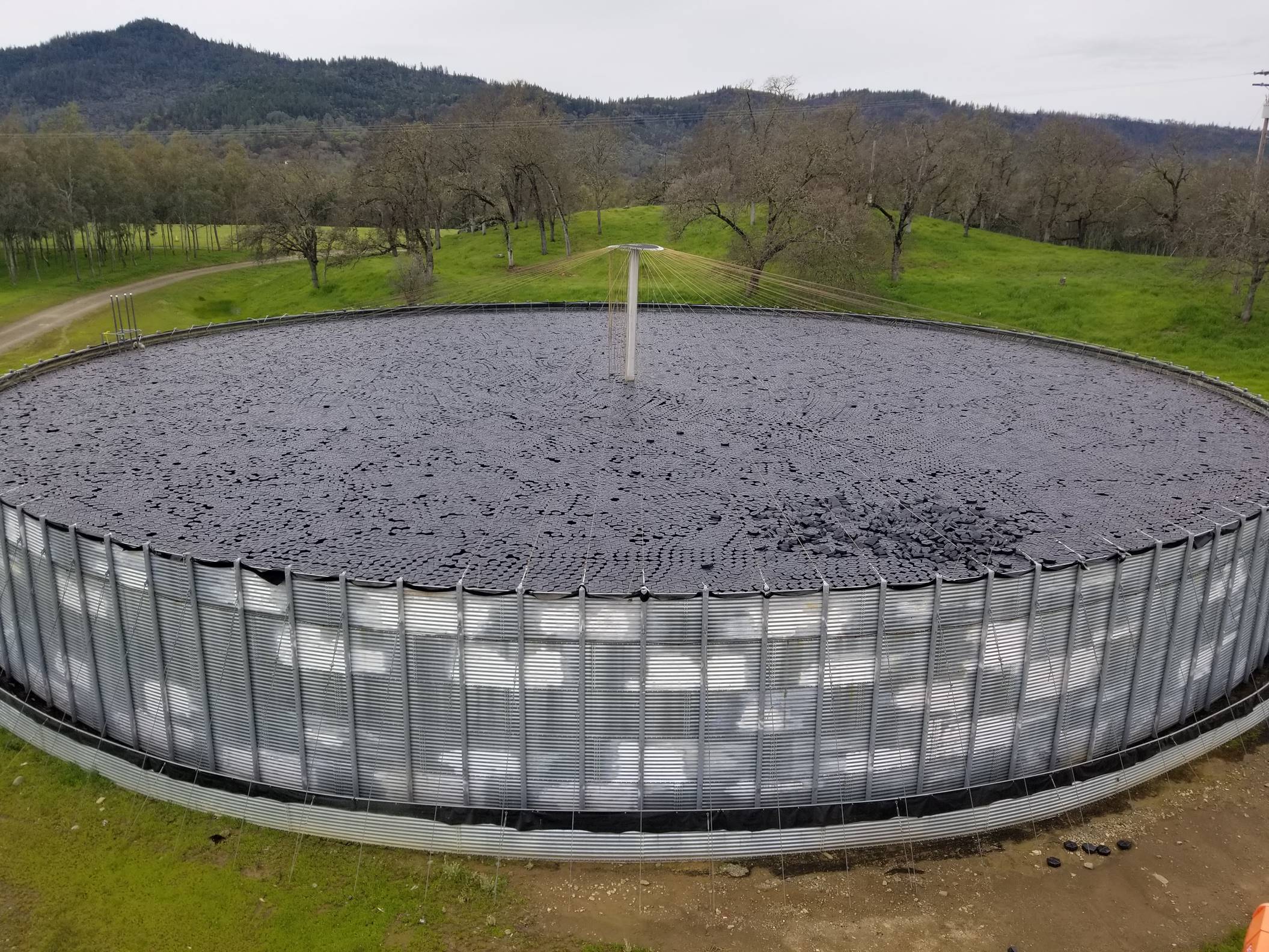
Application Summary
This profile documents how AWTT frames cover selection for data-center water storage. The honest scope is explicit: floating covers do not reduce cooling-tower evaporation — inside the tower that evaporation is the cooling. Covers protect the open buffers around the cooling system, where the industry shift to recycled water and on-site storage is creating larger and more numerous open ponds.
Problem Profile
- Potable-water withdrawals under public and regulatory scrutiny, driving a shift to recycled and on-site stored water
- Open makeup, reclaimed, stormwater, and blowdown ponds losing 60–100 inches of depth per year to evaporation in arid markets
- Reclaimed water breeding algae and biofilm that carry downstream into cooling-tower fill and heat exchangers, threatening uptime
- Solar heat gain warming thermal-storage and free-cooling ponds, shrinking usable cooling capacity
Site Conditions Considered
- Multiple open water bodies on site: raw/makeup storage, reclaimed reservoir, stormwater capture, blowdown holding, thermal storage
- Reclaimed or recycled water chemistry that must be screened for HDPE compatibility before specification
- Arid or water-stressed climate where evaporative loss directly increases net withdrawals to refill buffers
- Operator preference for a modular system standardizable across a fleet of facilities, with no basin modification
Selection Logic
- 1 Exclude the cooling tower from scope — covering the fill media would break the evaporative cooling mechanism.
- 2 Specify Hexprotect AQUA (up to 99% coverage) on reclaimed-water reservoirs where algae and biofouling control protect downstream cooling equipment.
- 3 Specify Rhombo Hexoshield (up to 98% evaporation reduction) where maximum water conservation on large storage buffers is the primary driver.
- 4 Specify Hexprotect MAX R (R-17+) on thermal-storage ponds where keeping stored water cold preserves cooling capacity.
- 5 Reference AWTT technical data for density, wind resistance, operating temperature, warranty, and expected service life.
Published, Verifiable Outcomes
- AWTT's Rhombo Hexoshield earned a 2017 U.S. Department of Energy Sustainability Award at the Savannah River Site, where it saved 55 million gallons of water per year on an open water body — a third-party-validated result.
- AWTT publishes up to 98% evaporation reduction for Rhombo Hexoshield and up to 99% surface coverage for Hexprotect AQUA.
- AWTT publishes a 130+ MPH wind-resistance rating for water-ballasted systems and an R-17+ insulation value for Hexprotect MAX R.
- Per-site savings are modeled from surface area, climate evaporation depth, and the published cover reduction; no private data-center customer measurements are published in this note.
Publication Disclosure
This is a modeled application note, not a named customer project report. It is appropriate for public linking because the credibility anchor (DOE Savannah River Site, 55 million gallons per year) is third-party validated, and all other figures are AWTT public specifications or transparently modeled estimates. It does not name a data-center customer or publish private operating data.