VOC Control for Oil & Gas — Tank Emissions and Produced Water Ponds
Modular HDPE covers that suppress volatilisation at the liquid surface. Up to 99% coverage, up to 98% evaporation reduction, 130 MPH water-ballasted — with an honest account of what a cover does and does not do under EPA and state air rules.
Volatile organic compound emissions in oil and gas come from a liquid surface. Whether that surface sits inside a fixed-roof crude tank or across an open produced-water pond, the mechanism is the same: light hydrocarbons move from the liquid phase into the vapour phase at the interface, and the size of that interface sets the rate. Every control strategy in the industry is ultimately a way of dealing with the consequences — capturing the vapour, burning it, or preventing it forming in the first place.
AWTT manufactures modular floating covers that address the third option. Rhombo Hexoshield® and Hexprotect® AQUA occupy up to 99% of the liquid surface, cutting evaporation by up to 98% and suppressing the volatilisation pathway that produces VOC, H₂S and odour emissions. They need no power, no chemical feed and no maintenance, they retrofit through existing access without taking a site off production, and they are rated to 130 MPH water-ballasted with a 25-year design life.
This page is deliberately specific about where that helps and where it does not. A modular cover is not a closed-vent system and does not by itself satisfy the 95% control standard that EPA NSPS Subpart OOOOb applies to storage vessels above the 6 ton-per-year VOC threshold. Where it wins decisively is on open impoundments — produced water ponds, evaporation pits, frac ponds and petrochemical wastewater basins — where there is no roof to vent from and reducing the emitting surface is the only lever available.
VaporLok Technologies — Oil & Gas Tank Emissions
VaporLok Rhombos are Rhombo Hexoshield® modular covers manufactured by Advanced Water Treatment Technologies (AWTT), a US manufacturer with more than 700 installations across 25 countries since 2004. The two names describe the same cover: AWTT builds it, and VaporLok Technologies deploys it inside oil and gas storage tanks.
VaporLok has been working with operators and regulators on tank emission suppression since 2016 and reports systems now reducing VOCs across nine states. Their patented retrofit internal floating roof approach is designed for smaller tanks where a conventional floating roof is uneconomic, and they report tank emission reductions of up to 80%, a minimum 50% VOC reduction from crude and condensate tanks, and truck loadout temperatures reduced from 140 °F to 100 °F. Those figures are VaporLok's own, published on their site.
If your problem is inside a crude or condensate tank, talk to them — they know that application better than anyone and we refer it to them directly. If your problem is an open impoundment, it comes to us as the manufacturer.
Inside-tank emissions work — crude and condensate storage, retrofit internal floating roof, TCEQ Emission Reduction Credit support.
Produced water ponds, evaporation pits, frac ponds and petrochemical wastewater basins — quoted by AWTT in partnership with VaporLok, shipped factory direct.
Related Engineering Guides
Floating Covers for Frac Ponds
The application page for produced water, flowback and completion fluid storage — wind ratings, wildlife exclusion, and the evaporation case for oilfield impoundments.
Floating Covers for Chemical Plants
Title V air permits, NESHAP hazardous air pollutants and EPCRA reporting — the petrochemical wastewater basin case, where the same surface-suppression argument applies.
Odor Control with Floating Covers
The underlying volatilisation-pathway mechanism, covering H₂S, ammonia, mercaptans and VOCs across industrial liquid containment.
Evaporation Control
How surface coverage translates into retained volume, with the calculator behind the evaporation numbers quoted on this page.
The Problem — Why Open Ponds Fail
Uncovered liquid storage creates measurable operational, environmental, and regulatory risks that floating covers directly address.
Flashing, Working and Breathing Losses from Storage Tanks
Crude oil and condensate tanks emit through three distinct mechanisms. Flashing losses occur when pressurised liquid enters the tank and dissolved light ends come out of solution. Working losses occur as vapour is displaced on every fill. Breathing losses occur as the vapour space expands and contracts with daily temperature and barometric swings. All three are driven by the exposed liquid surface and the headspace above it — and all three are counted against a site when TCEQ or a state permitting authority asks for working, breathing and flashing estimates.
Produced Water Ponds Have No Closed-Vent Option
A fixed-roof tank can be routed through a closed-vent system to a vapour recovery unit, enclosed combustor or flare. An open produced-water impoundment cannot. Evaporation ponds, flowback pits and frac ponds emit VOCs and hazardous air pollutants directly to atmosphere across their entire surface, and the only lever available is reducing the emitting surface itself. VOC and HAP emissions from produced-water surface disposal facilities are a live regulatory concern across the Rocky Mountain producing states.
Ozone Non-Attainment Puts Production Under Scrutiny
Ground-level ozone forms from nitrogen oxides reacting with volatile organic compounds in sunlight. Both the Colorado Front Range and the Houston/Galveston/Brazoria area are designated ozone non-attainment areas, and hydrocarbon storage is a named VOC source in each. Operators in these areas face tighter permit conditions, more monitoring, and more public attention than the same equipment would attract elsewhere.
BTEX and H₂S Are Worker-Exposure Problems, Not Just Air-Permit Ones
The vapour above produced water and crude carries benzene, toluene, ethylbenzene and xylene, frequently alongside hydrogen sulphide. Thief-hatch gauging, tank cleaning and pond-side work put people directly in that breathing zone. Suppressing volatilisation at the liquid surface reduces exposure at the source rather than relying on detection, ventilation and personal protective equipment after the fact.
Flaring and Combustion Carry Their Own Costs
Routing tank vapour to a flare or enclosed combustor solves an emissions problem by creating a fuel, maintenance, inspection and public-perception problem. Combustors need monitoring, pilot fuel and net-heating-value compliance work. Reducing the volume of vapour generated in the first place reduces the duty on whatever control device sits downstream — and in some cases changes the economics of whether one is needed at all.
Open Impoundments Create Wildlife Liability
Produced water ponds with an exposed hydrocarbon sheen attract waterfowl and migratory birds, creating Migratory Bird Treaty Act incidental-take exposure on top of the air-quality issue. Netting addresses the birds but does nothing for evaporation or vapour. A surface cover addresses both at once, which is why exclusion and emission suppression are usually specified together on oilfield impoundments.
The AWTT Solution
Modular, maintenance-free floating covers engineered to directly solve voc control challenges in industrial liquid containment.
Suppression at the Liquid–Air Interface
AWTT covers work by physically occupying the liquid surface, which is the only place volatilisation can happen. Rhombo Hexoshield® and Hexprotect® AQUA both reach up to 99% surface coverage, leaving only a small fraction of the liquid in direct contact with the vapour space. This is passive prevention before emission rather than treatment after volatilisation — no power, no chemical feed, no moving parts and no operator intervention.
Up to 98% Evaporation Reduction on Open Impoundments
The same surface barrier that suppresses vapour also holds water. Rhombo Hexoshield® delivers up to 98% evaporation reduction and Hexprotect® AQUA up to 95%. On a produced-water pond in West Texas or the DJ Basin, that is water that stays available for reuse in completions instead of being lost to the sky — and volume that never has to be replaced, trucked or disposed of.
Wind Ratings Built for Exposed Pad Sites
Water-ballasted Rhombo Hexoshield® 66 and Hexprotect® AQUA are rated to 130 MPH (209 km/h); Armor Ball® AQUA 275 is rated to 75 MPH. Those figures come from blower testing on a water tank in both empty and water-ballasted configurations, then validated against real weather — including multiple hurricanes passing directly over covered basins, most recently Hurricane Helene in September 2024. Unballasted covers are rated to 75 MPH and are not warranted above it.
Cold-Weather Service Without Freeze Damage
Rated from −70 °F to +160 °F (−57 °C to +71 °C) and frost resistant through repeated freeze–thaw cycling. Northern Colorado, the Bakken and the Powder River Basin put covers through winters that destroy rigid surface systems; modular HDPE units simply ride the surface and re-seat as ice forms and clears.
Retrofit Through Existing Access, No Downtime
Modular units go in through existing hatches and access points, in bulk bags, without draining the vessel, without welding, without civil works and without taking the site off production. On open impoundments the same units are simply placed on the surface. When a pad moves, the cover is recovered and redeployed rather than written off.
HDPE Formulated for the Chemistry It Sits In
Blow-moulded from UV-stabilised HDPE rated for high-TDS brines, BTEX compounds, hydrogen sulphide, scale and corrosion inhibitors, biocides and frac-fluid additives. Wall thickness and fluorinated resin are both available where a specific service demands more — see the hydrocarbon-service section below for an honest account of where HDPE has limits.
Where a Floating Cover Sits in the Regulatory Picture
This section exists because getting it wrong is expensive. A cover is a useful engineering control and a poor compliance shortcut, and the difference matters before you specify one.
What a modular cover is not
- Not a closed-vent system. EPA and state tank rules contemplate a cover forming a continuous impermeable barrier routed to a vapour recovery unit, enclosed combustor or flare. A segmented modular cover is neither continuous nor a vent route.
- Not, on its own, a demonstrated 95% control device for a storage vessel with a potential to emit at or above 6 tons per year of VOC under NSPS Subpart OOOOb.
- Not agency-approved. A CDPHE permit application for Rhombo Hexoshield® as VOC control is in review and has not been finalised; TCEQ discussions are ongoing. Nothing is approved today.
What it genuinely does
- Reduces the emitting surface, and with it the working and breathing component of tank losses — lowering the duty on whatever control device sits downstream.
- Provides the only practical surface control on open impoundments, where no closed-vent option physically exists.
- Produces a measurable, defensible before-and-after number when quantified with a direct mass-measurement protocol rather than a compositional model.
- Simultaneously addresses evaporation loss, bird exclusion, rain dilution and odour — problems that normally require separate systems.
The rules that usually apply
- EPA NSPS Subpart OOOOb / EG OOOOc
- The 2024 standards for the crude oil and natural gas source category, published 8 March 2024 and effective 7 May 2024. A storage vessel or tank battery with a potential to emit of 6 tpy or more of VOC must achieve 95% reduction of both VOC and methane. Compliance dates for several provisions were extended in 2025, and further amendments in April 2026 addressed flaring duration and net heating value monitoring — check current applicability for your equipment rather than relying on a summary.
- TCEQ and the Railroad Commission of Texas
- Jurisdiction over oilfield wastewater is split between the two. TCEQ requires site-specific or representative sampling together with working, breathing and flashing emission estimates for permitting — which is precisely why a directly measured emission factor is more useful than a modelled one.
- Ozone non-attainment areas
- Ground-level ozone forms from nitrogen oxides reacting with VOCs in sunlight. The Colorado Front Range and the Houston/Galveston/Brazoria area are both designated non-attainment, and hydrocarbon storage is a named VOC source in each — which is where both the scrutiny and the credit opportunities concentrate.
Measured Results from Producing Wells
The figures below come from field trials conducted by VaporLok Technologies on producing oil wells in Colorado, using the direct mass-measurement protocol described in the next section. They are specific trials on specific wells, not a general product rating — and the caveats travel with them.
Head-to-head on one active producing well
| Covering | Gas released | VOC reduction by volume |
|---|---|---|
| No cover | 218 cu ft/bbl | — |
| VaporLok solid membrane | 21.7 cu ft/bbl | 90% |
| Rhombo Hexoshield® AQUA | 11.4 cu ft/bbl | 95% |
"The difference between VaporLok and the Rhombos may be partially explained by the fact that the ambient temperature while testing the Rhombos was somewhat less than while using the VaporLoks. But in any case, the Rhombos are at least as effective, if not more so, than the VaporLok."
Five producing wells, northern Colorado
A five-well before-and-after programme run by VaporLok. Two of the five wells were covered with AWTT product; the other three used VaporLok's own membrane. Reductions across the whole programme ranged from 52% to 83%.
| Cover | Oil API | Before | After | Reduction | Net |
|---|---|---|---|---|---|
| Rhombo Hexoshield® | 43 | 82 lb/day | 26 lb/day | 68% | 10 t/yr |
| Hexprotect® AQUA | 36 | 101 lb/day | 17 lb/day | 83% | 15 t/yr |
| VaporLok membrane | 38 | 186 lb/day | 52 lb/day | 72% | 24 t/yr |
| VaporLok membrane | 65 | 92 lb/day | 32 lb/day | 65% | 11 t/yr |
| VaporLok membrane | 72 | 122 lb/day | 58 lb/day | 52% | 11 t/yr |
Source: VaporLok, Inc. field trial reports, northern Colorado. Reproduced with the original figures and caveats intact. Reductions on any given site depend on surface area, liquid chemistry, temperature and operating pattern — treat these as evidence that the mechanism works, not as a rating for your tank.
How the Emissions Were Measured
The common industry approach is to infer tank emissions from crude composition fed into a software model. The trials above used a direct mass measurement instead, which is both harder to argue with and easier to bring to a regulator. This is the protocol in full — the site-specific emission factor method.
-
Install a temperature- and pressure-compensated mass flow meter with a totaliser on the tank vent — or between the tank and the combustor where a control device is present.
-
Gauge the tank before and after the test window so barrels produced over the measurement period are known.
-
Draw a one-litre gas sample after a minimum one-minute purge through the sample cylinder, sealed at both ends.
-
Analyse the sample per ASTM D7833-14 and enter the resulting composition into the meter gas-select function, so the mass calculation reflects the actual gas rather than an assumed one.
-
Record totalised flow continuously for 48 hours, covering at least one full daily temperature cycle so breathing losses are captured.
-
Calculate: standard cubic feet × VOC gas density (lb/scf) = VOC weight (lb), then VOC weight ÷ barrels produced = emission factor (lb/bbl).
Worked example
A well producing 2,218 bbl/yr. Over a 48-hour window the meter totalised 263 scf against 11.4 bbl produced, with a VOC gas density of 0.0668 lb/scf per ASTM D7833-14 — 17.5 lb of VOC, giving an emission factor of 7.9 lb/bbl, or 8.76 tons per year. After the cover was installed the same procedure gave 1.54 lb/bbl, or 1.70 tons per year — an 80% reduction, expressed in a unit a permit writer can use directly.
HDPE in Hydrocarbon Service — What We Tell Regulators
When TCEQ asked how long HDPE lasts in crude oil, there was no clean answer in the public literature — so we wrote one. This is the same technical account we provided for a state regulatory submission, published here unchanged, because an operator specifying a cover deserves the information the regulator got.
Swelling and absorption
Aromatic hydrocarbons in crude — benzene, toluene, ethylbenzene, xylene — absorb into HDPE because the chemistry is similar, causing the material to swell and lose mechanical strength over time.
Permeation
Hydrocarbons and dissolved gases — CO₂, H₂S, methane — migrate through the HDPE wall. This is why monolayer HDPE does not meet modern vapour-emission standards, and why fuel-tank manufacturers moved to multilayer HDPE/EVOH, HDPE/nylon or fluorinated constructions.
Environmental stress cracking
Under tensile stress combined with hydrocarbon exposure, HDPE can fail by brittle cracking at stresses well below its short-term strength. Higher-ESCR grades (PE100+ or equivalent) handle this significantly better.
The honest summary
Chemical compatibility charts typically rate HDPE against crude oil as limited — often "fair" to "severe effect" rather than fully resistant, which is why crude does not appear cleanly on most charts. Temperature matters a great deal: HDPE is generally considered suitable for hydrocarbon service up to roughly 45–60 °C (115–140 °F), with published data showing accelerated cracking and a sharp drop in elongation above about 80 °C (175 °F).
For ambient-temperature oil-tank emissions-control service, HDPE gives a long service life — but that life drops significantly with higher temperatures, high aromatic or H₂S content, or stress concentrations in the part. A Rhombo recovered after four years inside an oil tank was slightly swollen but structurally intact. None of this applies in the same way to produced-water ponds and frac pits, where the liquid is brine rather than crude and the standard 25-year design life holds.
If your service is aggressive, we can change the part
We blow-mould the Rhombo Hexoshield® in grade 5502 HDPE at a nominal wall of 1–2 mm. Wall thickness can be increased without re-tooling — the machines have electronic wall adjustment — which delays swelling and preserves structural integrity for longer, though it will not necessarily eliminate the effect. Alternatively the part can be produced in fluorinated HDPE, either as post-mould surface treatment or as a fluorinated resin. Both cost more. Which is right depends on your crude, your operating temperature and the service life you need, so talk to us about the specific application rather than ordering a standard part and hoping.
When a Verified Reduction Becomes an Asset
In some airsheds a quantified VOC reduction is worth more than the cost it avoids. In the Houston/Galveston/Brazoria ozone non-attainment area, the Texas Commission on Environmental Quality operates an Emission Banking and Trading programme under which certified reductions can be issued as Emission Reduction Credits, then banked or traded. Our partner VaporLok Technologies works this route directly with operators in the HGB area.
The five-well Colorado programme also quantified the carbon side: the two wells covered with AWTT product recorded 30 and 45 tons per year of CO₂ credits respectively, with the full five-well range running from 30 to 72 tons per year per well. Whether those translate into a saleable instrument depends entirely on the programme and the jurisdiction.
Eligibility, quantification protocol and certification are at the discretion of the relevant authority and depend on your site, your baseline and your permit history. Treat this as a route worth investigating with your air-quality consultant, not as a commitment from us.
Where This Is Already Deployed
Customer identities are confidential; the applications and volumes are not.
Petrochemical plant, Houston Ship Channel
Approximately 46,000 sq ft of Rhombo Hexoshield® on wastewater storage ponds to reduce VOC emissions, following an on-site evaporation trial. Specified while the operator worked the permitting question with TCEQ.
Flavour and fragrance manufacturer, Florida
Rhombo Hexoshield® 189 deployed for vapour reduction on process water surfaces at a Jacksonville production site.
Petrochemical complex, Saudi Arabia
Hexprotect® AQUA installed in response to a government compliance requirement, with a written acknowledgement from the operator following installation.
Oil and gas producers, nine US states
Rhombo Hexoshield® covers deployed inside crude and condensate storage tanks by VaporLok Technologies, who report emission suppression systems now operating across nine states.
Technical Specifications — VOC Control Floating Covers
Recommended Products for VOC Control
AWTT engineers recommend these floating cover systems for voc control applications.
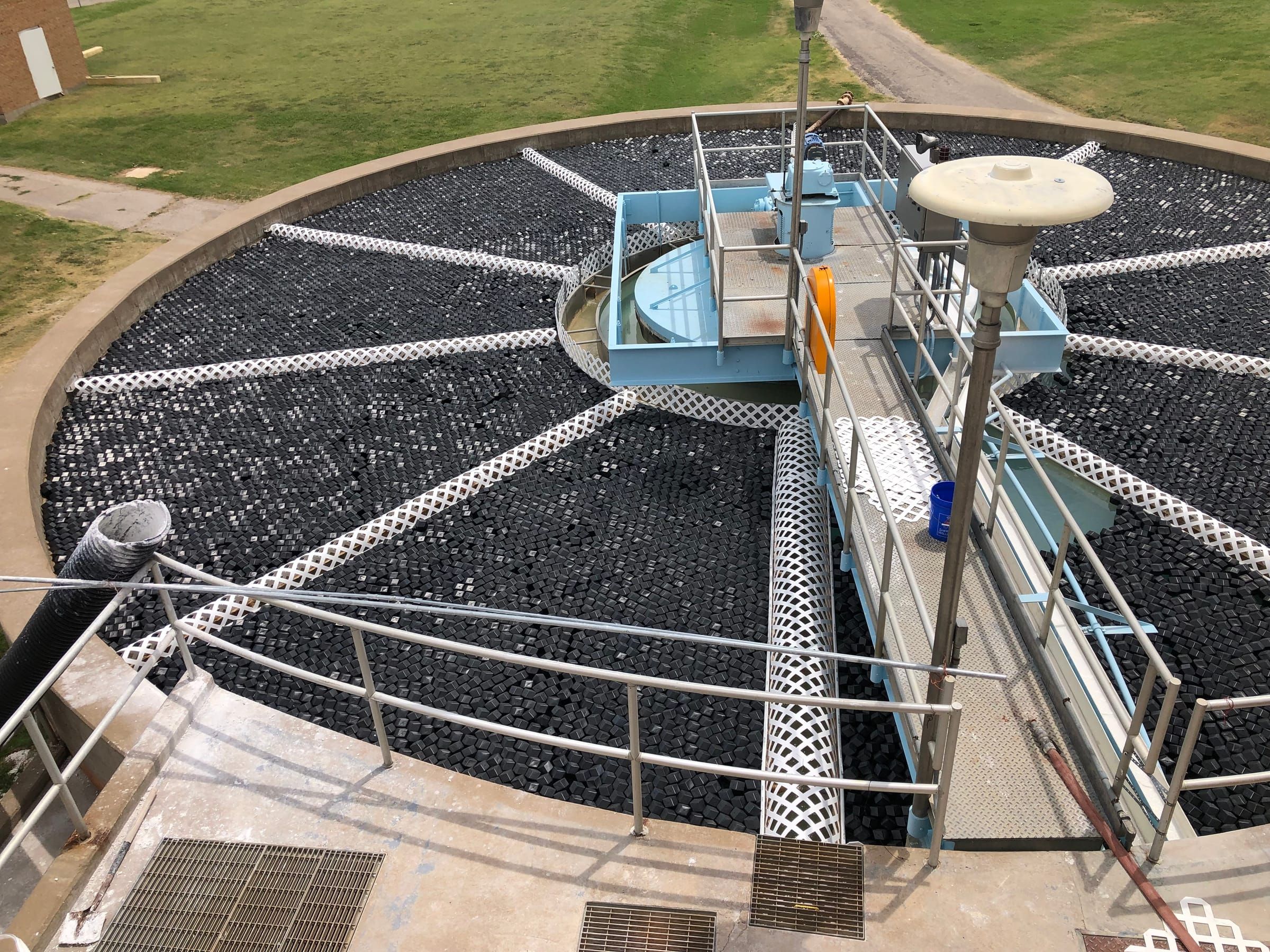
Up to 99% coverage | 130 MPH ballasted | R-4 | 25 lb/ft²
Rhombo Hexoshield® 66
The patented rhombus-hexagonal panel VaporLok Technologies sells as Rhombos. Highest coverage and the highest wind rating in the range, walkable at 25 lb/ft², and the unit used in the northern Colorado field trials described below. First choice for produced-water ponds and for in-tank work through existing access points.
Learn more →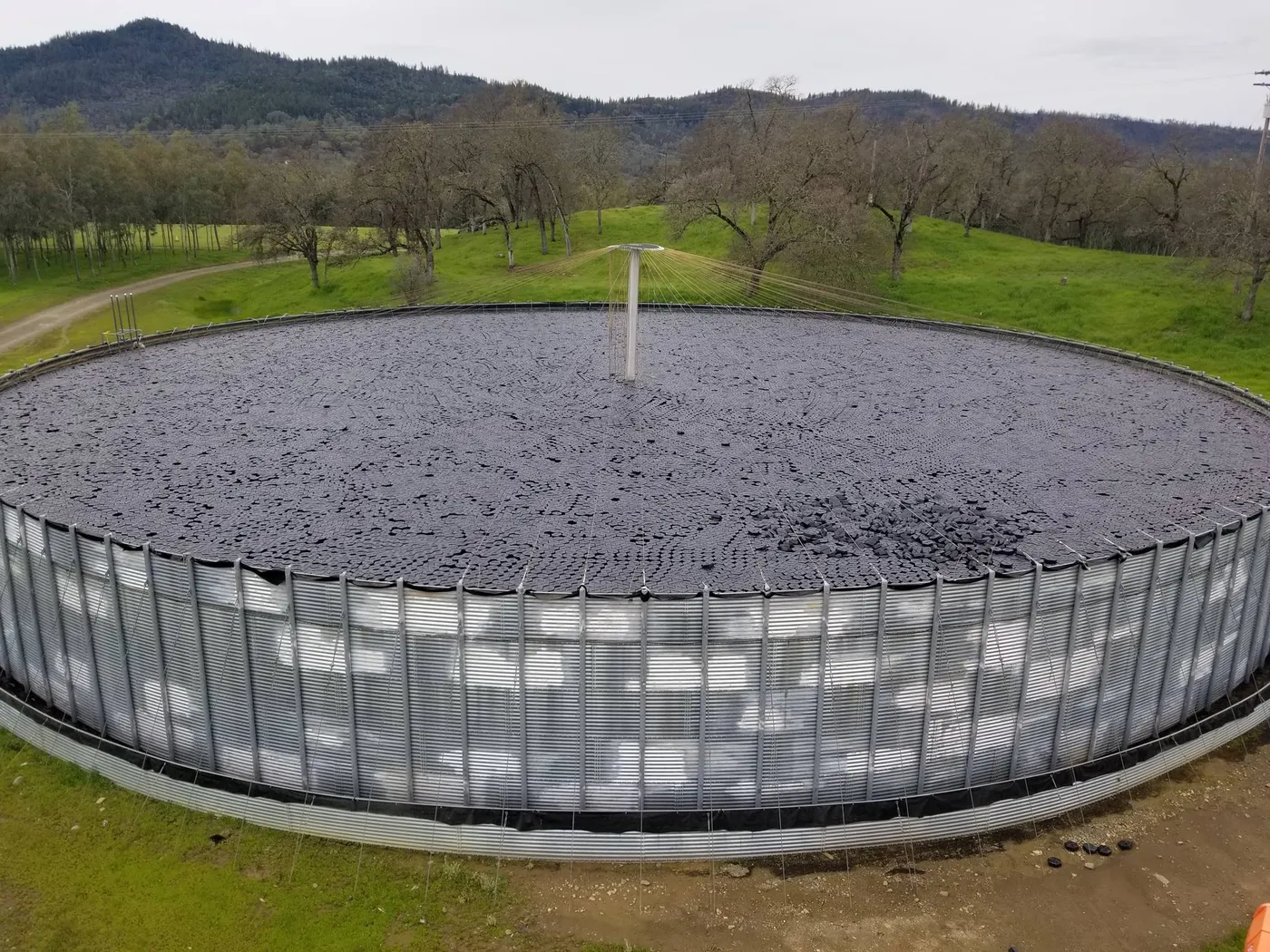
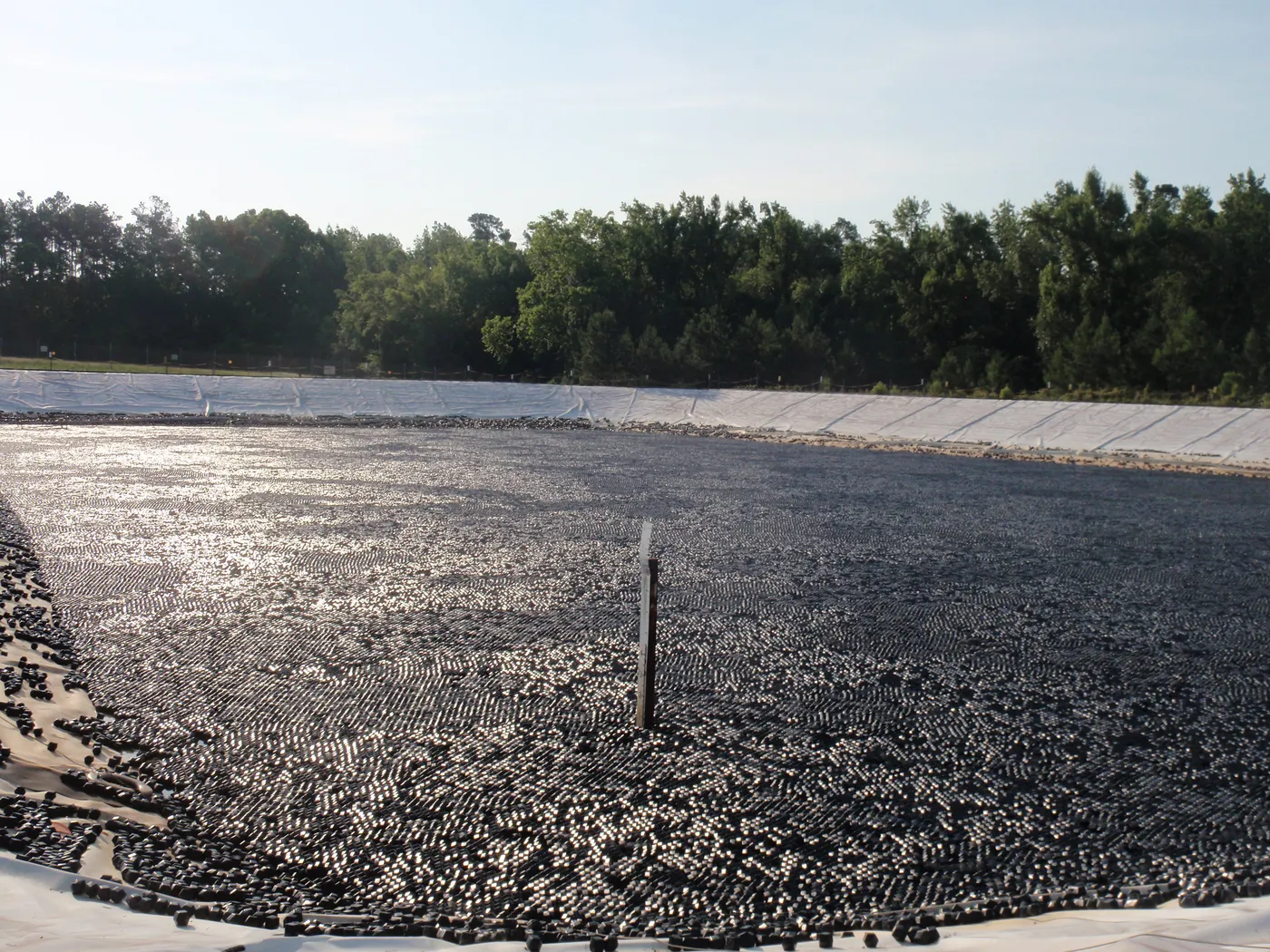
Up to 99% coverage | 130 MPH ballasted | NSF/ANSI 61 resin option
Hexprotect® AQUA
Water-ballasted hexagonal tile at 220 mm, up to 95% evaporation reduction and R-2 insulation. The only product in the range offered in NSF/ANSI 61 certified, FDA-compliant resin — note that the certification is held by the resin, not the finished cover assembly. Recorded the strongest single-well result in the five-well Colorado trial.
Learn more →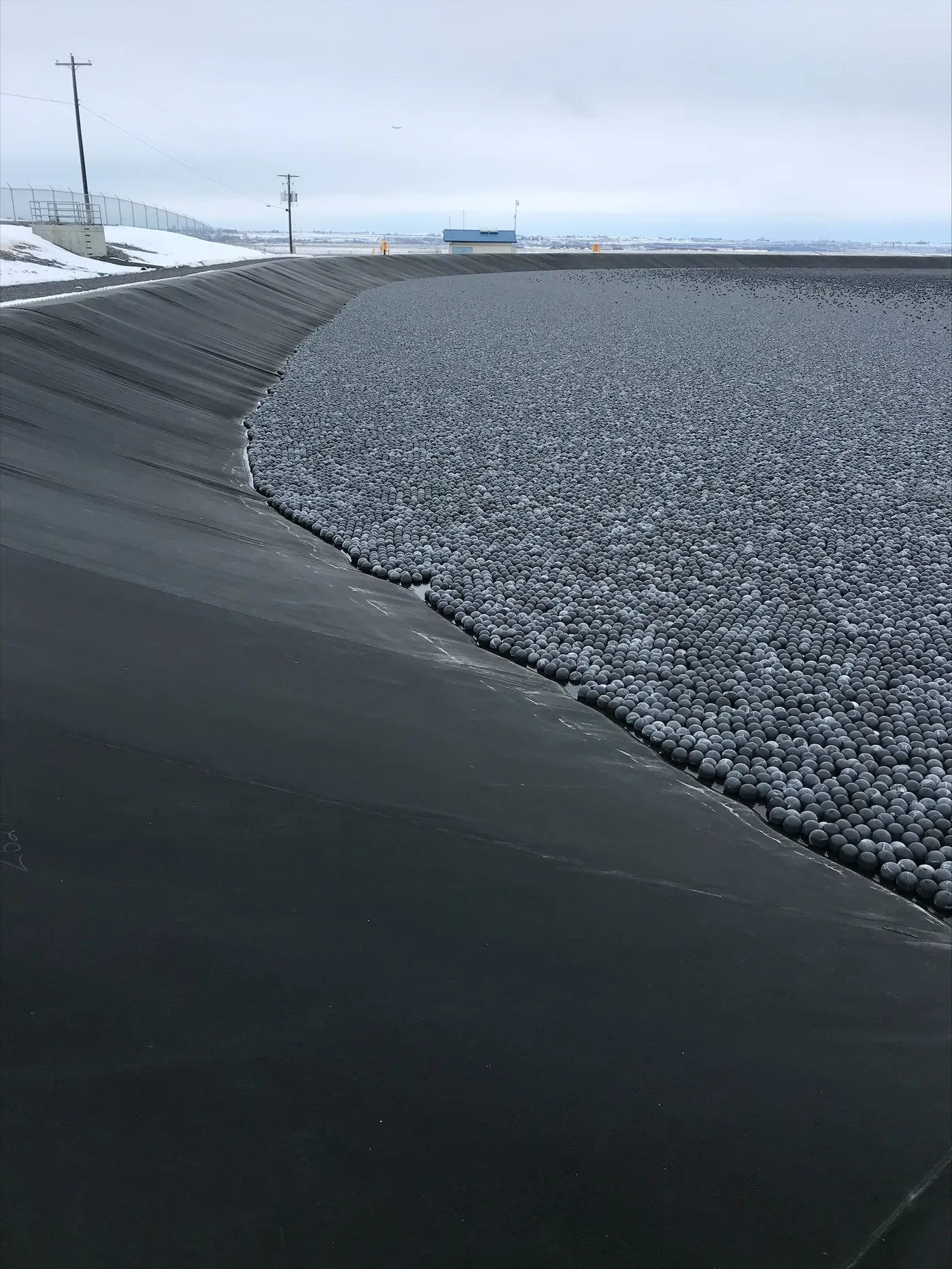
91% coverage | 75 MPH | Water-ballasted sphere
Armor Ball® AQUA 275
Water-filled sphere for large, irregular or temporary impoundments where speed of deployment and cost per square foot matter more than maximum coverage. Pours in from bulk bags, self-levels, and is the simplest unit to recover and redeploy when a pad moves.
Learn more →Frequently Asked Questions — VOC Control
Common questions from engineers and operators evaluating AWTT floating covers for voc control.
Does a floating cover make a storage tank compliant with EPA NSPS OOOOb?
Has any regulator approved AWTT or VaporLok covers for VOC control?
Where does a floating cover genuinely win in oil and gas?
What VOC reduction has actually been measured with AWTT covers?
How were those emissions actually measured?
How long does HDPE last inside a crude oil tank?
Can the covers be made more resistant for aggressive crude service?
Where does VaporLok Technologies fit, and where does AWTT?
Can verified VOC reductions be turned into tradeable credits?
What does a floating cover not do?
Ready to Solve Your VOC Control Challenge?
Contact AWTT for a custom floating cover recommendation — including site assessment, specification sheets, and ROI analysis.
Engineering Tools & Resources
Evaporation Rate Calculator
Estimate evaporation losses on your pond or reservoir and the ROI of a floating cover, using five FAO-56 / Harbeck methods with real-time weather.
Heat Loss & ROI Calculator
Model heat loss from a heated pond with the ASHRAE 5-component balance, then compare insulation savings and 20-year cost of ownership.
Not Sure Which Cover?
Answer a few questions about your site conditions and get a personalized product recommendation.
Technical Specifications
View full engineering specs, wind resistance data, R-values, and material compliance details.