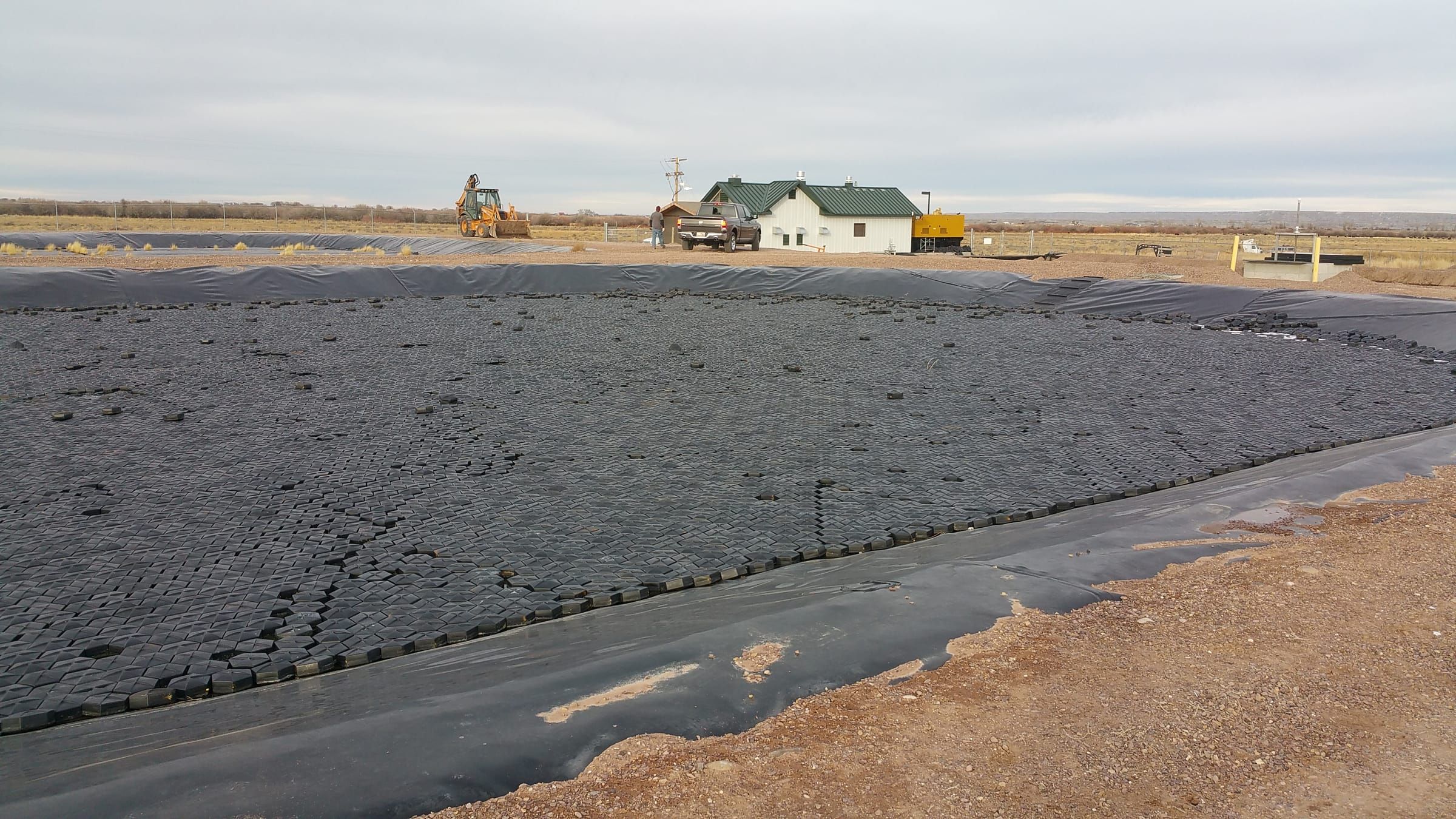
Pond Evaporation Rate Calculator — Penman-Monteith, Aerodynamic & Mass-Transfer Methods
Quantify open-pond water loss with real-time weather data using your choice of physical model — Penman-Monteith (FAO-56), aerodynamic mass-transfer, or empirical mass-transfer — and see exactly how much each AWTT floating cover would save.
Open-pond evaporation is the single largest uncontrolled water loss in industrial liquid storage — and the most expensive to leave unmeasured. The AWTT Evaporation Loss Calculator applies the aerodynamic mass-transfer method (Magnus saturation vapor pressure, wind-profile normalization, Lake Hefner fetch reduction) using real-time weather data from your specific site — temperature, relative humidity, wind speed — to estimate daily and annual evaporation loss in gallons or liters.
For each AWTT cover product (Armor Ball®, Armor Ball® AQUA, Hexprotect® AQUA, Hexprotect® SLIM, Hexprotect® MAX R, Rhombo Hexoshield®, Rhombo Hexoshield® 189), the calculator displays the projected covered evaporation rate and the resulting annual water saved. Use it to size a cover capital budget against a measurable annual water-loss baseline — for municipal reservoirs, agricultural irrigation storage, mining tailings ponds, biogas digesters, frac ponds, and industrial process water systems.
Evaporation Loss Calculator
Estimate daily water loss using the FAO-56 Penman-Monteith reference method (default) — pick from five physical models and see how much an AWTT cover saves
Pick the physical model. All five share the same site inputs where applicable; results typically agree within 10–20% for moderate conditions (0–30 °C). The simplified empirical method can diverge significantly above 30 °C, where its humidity-ratio polynomial loses accuracy.
Formula
E = (Δ·(R_n − G) + γ · (900 / (T_a + 273)) · u_2 · (e_s − e_a)) / (λ·(Δ + γ·(1 + 0.34·u_2)))
Variables: E = evaporation rate (mm/day); Δ = slope of saturation vapor pressure curve at T_a (kPa/°C); R_n = net radiation at water surface (MJ/m²/day, from sunshine hours & albedo); G = soil/water heat flux (MJ/m²/day, ≈ 0 daily); γ = psychrometric constant (kPa/°C); u_2 = wind speed at 2 m (m/s); e_s = saturation vapor pressure at T_a (kPa); e_a = actual vapor pressure (kPa); λ = latent heat of vaporization (≈ 2.45 MJ/kg).
Best for: Regulatory or peer-reviewed reporting; sites with measured sunshine hours or solar radiation.
References: Allen et al. (1998), FAO Irrigation & Drainage Paper 56; Monteith, J.L. (1965), "Evaporation and environment", Symp. Soc. Exp. Biol. 19; Penman, H.L. (1948), Proc. Royal Soc. A 193 (doi:10.1098/rspa.1948.0037)
Quick scenarios
Tip: use the Surface Area Estimator above to calculate this value first
Review calculator assumptions
- No site location has been fetched yet. The calculator is using generic default weather until you enter a city or ZIP code and fetch live data.
Edit any field to override the fetched value:
Daily Evaporation Results
Depth across water surface
Annual Water Loss Comparison
Based on today's fetched conditions — fetch weather for a specific location to use 12-month climate normals
380,872 gal/year saved annually (97% reduction)
Custom Period Loss
Total water loss over your selected day count (30 (days))
↳ 31,305 gal saved in this period
Annual Water Cost Saved
$1,904
@ $5.00 / 1,000 gal
CO₂ Reduction
2,768 lbs/yr
from reduced water treatment & pumping
Equivalent To
57.7 trees
planted per year
Water Value Stack
Tariff price is the floor, not the value. The stack layers in what the saved water is actually worth — replacement supply, productive use, drought-year option value, and physical co-benefits — so the ROI survives scrutiny from a CFO or lender.
(?)
Gallons saved × your local water rate. The conservative anchor — what your tariff actually charges. Method: commodity / market price (Young & Loomis 2014).
Source
Young & Loomis 2014 — commodity / market price
Read the full methodology →(?)
Gallons saved × cost per acre-foot of the next unit of new supply you would otherwise develop (treated surface, reuse, desal). Method: alternative-cost / replacement-cost (Pacific Institute benchmarks; Carlsbad desal ≈ $2,100–$2,800/AF).
Source
Pacific Institute, treated surface / agricultural conveyance
Read the full methodology →(?)
Gallons saved × marginal value of water in its highest and best use (residual value / value of marginal product). FAO Paper 66 crop-water production functions; Grafton et al. 2023.
Source
FAO Paper 66 (Steduto et al. 2012) permanent-crop residual value
Read the full methodology →(?)
P(shortage year) × (drought $/AF − normal $/AF) × AF saved. Captures the value tariff math misses entirely. Griffin & Mjelde 2000; SJV Water 2014–2022 drought sales ($1,600–$9,230/AF).
Source
SJV Water 2014–2022 drought-period sales; Nature Sustainability 2022
Read the full methodology →(?)
Independent benefit streams: chemistry / treatment, slower TDS concentration, suppressed evaporative heat loss, VOC / emissions controls. Genuinely additive — not double-counting the water itself.
Source
Algae / chemistry savings and TDS-concentration avoidance, agricultural ponds
Read the full methodology →1.17 acre-feet saved / year
Conservative
$1,904 / year
T0 only — tariff floor
Central
$1,981 / year
best-use + co-benefits
Comprehensive
$2,296 / year
+ expected drought value
Methods follow Young & Loomis 2014 (commodity, alternative-cost, residual-value, shadow-price, reliability, avoided-damage). The Central total uses max(T0, T1, T2) so the same gallon is never valued twice — when a tariff prices near scarcity, T0 itself is the best use. T3 and T4 are independent streams that add cleanly. Read the full methodology →
Lifecycle ROI (20-year NPV / IRR)
Project each Value Stack scenario across the cover's service life. Simple payback structurally hides drought-year option value because that value only shows up in occasional years; NPV and IRR are how agricultural lenders and infrastructure investors actually underwrite long-life water assets.
years. AWTT design life is ~20 years.
% per year. 6% is a typical agricultural / utility weighted cost of capital.
% per year. Raw water prices have roughly tripled in a decade; a 3% default is conservative.
$. Total turnkey installed cost. Enter 0 to model savings only (IRR / payback are then undefined).
| Scenario | Lifetime savings (nominal) | NPV @ discount | IRR | Payback |
|---|---|---|---|---|
| Conservative (T0) | $51.2k | $27.7k | — | > life |
| Central (best-use + T4) | $53.2k | $28.8k | — | > life |
| Comprehensive (+ T3) | $61.7k | $33.4k | — | > life |
NPV = sum of discounted cash flows minus install cost. IRR = discount rate that zeros NPV (only meaningful when install cost is set). Payback = year discounted cumulative cash flow crosses install cost. See methodology page for the discipline behind these numbers.
Pick the right cover for these conditions
We carry pre-filtered options based on your area, climate, and reservoir type.
Calculation detail
#01ng58da · v0.0.1-dev
Annual Loss by Cover Type
Continuous solid floating covers reduce evaporation ~95% at full coverage (Yao et al. 2021, J. Hydrology 599; Craig et al. 2005, USQ NCEA). AWTT product values reflect AWTT’s 2012–2013 field studies, strictly monitored for evaporation and algae reduction. Switch products above to compare.
Get a Personalized Evaporation Report
Receive a detailed PDF with your site-specific evaporation analysis, product recommendations, and savings projections.
Worked Examples — Industrial Evaporation Loss
Three end-to-end scenarios with real inputs, numbers, and AWTT cover savings. Plug the same conditions into the calculator above to reproduce them and see the per-product breakdown.
Example 1 — 5-Acre Irrigation Pond, Central Texas (Summer)
Inputs: 5 acres (20,234 m²) surface area, 5 ft depth, central Texas in July, 95 °F (35 °C) air, 35% RH, 9 mph (4 m/s) wind, full-sun exposure, water cost $1,200/acre-foot ($3.68/1,000 gal). Aerodynamic mass-transfer method.
Result: The vapor-pressure deficit at the surface drives evaporation at about 9.2 mm/day (≈ 0.36 in/day). On 5 acres this works out to roughly 49,000 gal/day of lost water — about 17.9 million gallons per year (55 acre-feet). At $3.68/1,000 gal the annual water-loss cost is ≈ $66,000/year.
With Hexprotect MAX R cover (98% reduction): annual loss drops to ~360,000 gal/year, saving ≈ $64,700/year on water alone — before counting cover-driven reductions in algae treatment and silt buildup. With cover capital of $150,000–$250,000 on a 5-acre pond, payback is in 2.5–4 years.
Example 2 — 50,000 bbl Mining Tailings Pond, Atacama Desert (Year-Round)
Inputs: ~7,950 m² (50,000 bbl ≈ 2.1 ML at 4 m depth, ≈ 0.8 ha surface), 4 m depth, Atacama at average 22 °C, 18% RH, 6 m/s wind, fetch 100 m, salinity 5% (typical leach pond TDS), full sun. Penman-Monteith with sunshine hours = 12 h/day, albedo 0.10.
Result: Penman-Monteith returns about 11.5 mm/day; the aerodynamic method on the same site returns 12.8 mm/day — agreement within 12%, with PM lower because radiation is partially offset by high outgoing longwave at low humidity. The high salinity reduces the rate ~5%. Daily loss ≈ 89,000 L/day (23,500 gal/day) — ≈ 32.5 million L/year (8.6 M gal/year).
With Armor Ball cover (85% reduction): remaining ~4.9 million L/year. For a tailings facility where replacement leachate is trucked at $0.04–0.08/L, this corresponds to $1.1M–2.2M/year of avoided make-up water and chemistry restabilization. Fetch and salinity are central to this calculation — calculators that omit them under-predict by 20–30%.
Example 3 — 10 MG Potable Reservoir, Central California
Inputs: 10 million gallons (37,854 m³) at 12 ft depth ≈ 6 acres (24,000 m²) surface, Central California annual mean 18 °C, 55% RH, 3 m/s wind, partial shade (basin walls), water cost $1.50/1,000 gal (municipal raw water). Penman-Monteith with derived sunshine hours.
Result: About 4.8 mm/day annual average — lower than the desert example because of cooler temperatures and higher humidity. Daily loss ≈ 30,400 gal/day, annual loss ≈ 11.1 M gal/year (34 acre-feet). At $1.50/1,000 gal the financial loss is ≈ $16,650/year. The monthly chart in the calculator above shows that July–September accounts for ≈ 55% of the annual loss; sizing a cover for peak demand months captures most of the savings.
With Hexprotect AQUA (95% reduction): annual loss ~555,000 gal/year, saving ≈ $15,800/year in water cost plus reduced chlorine demand (covered reservoirs hold disinfectant residual longer because UV-driven decay is blocked).
Which Calculation Method Should I Use?
All five methods are physically valid; pick the one that matches your site and the data you have.
| Method | Best for | Required data |
|---|---|---|
| Aerodynamic Mass-Transfer (default) | Industrial ponds, wind-driven sites, sites without measured solar; fastest convergence to observed evaporation at AWTT use cases. | T_air, RH, wind, T_water |
| Penman-Monteith (FAO-56) | Sites where solar input dominates (clear, sunny, low-wind reservoirs); regulatory or peer-reviewed reporting; cross-checks against the aerodynamic result. | Above + sunshine hours + albedo |
| Priestley-Taylor | Open lakes and reservoirs in calm, humid climates; the hydrology-textbook default for water surfaces — drops the wind term and lets radiation drive the result. | T_air, RH, sunshine hours, albedo |
| Hargreaves-Samani | When humidity, wind, and solar are all unavailable — FAO-56 recommends Hargreaves-Samani as the fallback because it needs only air temperature. | T_air (latitude derived from location) |
| Mass-Transfer (Empirical) | Direct apples-to-apples comparison with simpler online calculators; educational reference; quick sanity check. | T_air, RH, wind, T_water (0–30 °C only) |
Recommendation: for AWTT cover-sizing decisions, run the default Aerodynamic method, then switch to Penman-Monteith and confirm the two agree within 15%. A larger divergence usually means a fetch or sunshine-hours input that needs review. For open lakes specifically, Priestley-Taylor is the textbook starting point.
Industrial Evaporation Scenarios
Five concrete site profiles for the most common AWTT cover-sizing decisions. Each section names the typical inputs, the expected daily and annual loss, and the calculator preset you can run to reproduce the numbers above.
Mining Tailings Pond Evaporation
Mining tailings ponds in arid climates — Chilean Atacama, US Southwest copper belts, Australian iron belts, southern Africa — combine the four conditions that maximise open-water evaporation: high solar input, sustained low humidity, persistent wind, and elevated water temperature from process heat. Tailings ponds also carry high total dissolved solids (3–20% salinity is typical for leach circuits and SX-EW raffinate), which reduces vapour pressure at the surface by 5–15% and partially offsets the climatic driver — but only partially. Aerodynamic and Penman-Monteith methods both account for salinity correction in the AWTT calculator; competitors that omit it under-predict losses by 20–30%.
Typical daily loss on a 1-hectare leach pond in the Atacama at 22 °C / 18% RH / 6 m/s wind is 10–13 mm/day (Penman-Monteith 11.5, aerodynamic 12.8 — within 12% of each other), or ~89,000 L/day — about 32.5 million L/year (8.6 M gal/year) before cover. AWTT Armor Ball® AQUA (85% reduction) leaves residual ~4.9 M L/year; Hexprotect® AQUA (~95%) leaves ~1.6 M L/year; Rhombo Hexoshield® (up to 98%) leaves under 700 k L/year. At trucked make-up water costs of $0.04–0.08/L, even the entry-level cover saves $1.1M–2.2M/year on a single 1-ha pond. Run this scenario via the calculator's "Mining tailings" preset and select Penman-Monteith or Aerodynamic mass-transfer. See also AWTT's mining tailings floating covers page for cover-selection guidance.
Agricultural Irrigation Reservoir Evaporation
Agricultural irrigation reservoirs in the US Central Valley, Murray-Darling Basin, Israel/Jordan, and southern Spain operate on tight water budgets where summer evaporation removes a significant fraction of the available irrigation supply before delivery. A 5-acre irrigation pond in central Texas in July (95 °F air, 35% RH, 9 mph wind, full sun) loses ~9.2 mm/day or 49,000 gal/day — about 17.9 M gal/year (55 acre-feet). At a Central Valley raw-water cost of $1,200/acre-foot ($3.68/1,000 gal), that is roughly $66,000/year of stored water destroyed before a single drop reaches a furrow.
A high-coverage AWTT cover (Hexprotect® MAX R or Rhombo Hexoshield® at 96–98% reduction) brings the annual loss down to ~360,000 gal/year — saving ~$64,700/year on water alone, with cover payback in 2.5–4 years on typical 5-acre installation cost of $150,000–$250,000. The savings scale roughly linearly with surface area, so a 50-acre district reservoir saves on the order of $650,000/year and the per-acre cover cost typically falls with scale. Run this scenario via the calculator's "Agricultural irrigation" preset.
Municipal Water Supply Reservoir Evaporation
Municipal potable reservoirs in moderate California, central Spain, or south-eastern Australia evaporate less per square metre than desert mining ponds — but the absolute volume is large because the surface area is large. A 10 MG potable reservoir at 6 acres surface area (24,000 m²), Central California, 18 °C / 55% RH / 3 m/s wind, partial-shade basin: about 4.8 mm/day annual mean, ≈ 30,400 gal/day, ≈ 11.1 M gal/year (34 acre-feet). At municipal raw-water cost of $1.50/1,000 gal that is ≈ $16,650/year in water value alone, before counting reduced chlorine demand (covered reservoirs hold disinfectant residual longer because UV-driven decay is blocked).
Hexprotect® AQUA at 95% reduction brings annual loss to ~555,000 gal/year and saves ~$15,800/year in water cost plus the chlorine-stability bonus. The calculator's monthly distribution chart shows that July–September accounts for ≈ 55% of the annual loss, which is why utilities sizing a cover for peak-demand season recover most of the value. Run this scenario via the "Municipal water supply" preset and check AWTT's reservoirs industry page for product selection logic.
Biogas Digester Evaporation & Heat Loss
Anaerobic digesters and biogas lagoons operate at 35 °C (mesophilic) or 55 °C (thermophilic) and lose energy by three coupled mechanisms at the liquid surface: long-wave radiation, convective heat exchange, and evaporative cooling. Evaporation alone removes ~2,450 kJ per kg of water lost, which on a 1-acre mesophilic lagoon at 6 mm/day works out to ~55 GJ/day of supplemental heat that must be supplied to hold operating temperature. In cold-climate operations (Wisconsin, Bavaria, Quebec) this drives biogas-plant operating cost as much as feedstock procurement does.
AWTT's Hexprotect® MAX R insulated floating cover combines up to 99% surface coverage (suppressing evaporative cooling) with R-17+ closed-cell foam insulation (suppressing conductive loss). Run the evaporation calculator with the "Biogas digester" preset to size the evaporative component, then run the heat-loss calculator with the same site to add the conductive and radiative components. The sum is the supplemental-heating saving that AWTT's biogas case studies typically report.
Frac Pond & Produced-Water Evaporation
Hydraulic fracturing operations store produced water and flowback in surface impoundments that face the worst of three operating environments: arid Permian / Eagle Ford / Bakken climates, sustained 25–35 mph wind exposure that makes conventional covers fail, and high-TDS produced-water chemistry (often 100,000–200,000 mg/L). A 2-acre frac pond in the Permian at 32 °C / 22% RH / 7 m/s wind with 12% salinity loses 6–9 mm/day (salinity-corrected; the climatic driver would push 10+ mm/day before correction) — about 12,000–18,000 gal/day or 4.4–6.6 M gal/year per pond.
AWTT Armor Ball® AQUA 275 is purpose-built for frac pond conditions: 75 MPH wind rating without anchoring, one-day deployment by a two-person crew, fully redeployable as the pad rotates. At ~85% evaporation reduction the residual loss is 660,000–990,000 gal/year per pond; at typical produced-water trucking cost of $0.50–$3/bbl, that is $8,000–$70,000/year saved per pond before counting reduced VOC emissions and MBTA exposure. Run this scenario via the "Frac pond" preset and reference the frac ponds industry page for product-selection logic.
Calculation Methods Explained
Each of the five physical models below is selectable from the calculator's Method dropdown. Pick the method that matches the data you have on site, not the most theoretically rigorous — Penman-Monteith is the international reference but loses accuracy quickly when its input data is estimated rather than measured.
Penman-Monteith (FAO-56) Calculator
Penman-Monteith is the international reference standard for reference evapotranspiration, codified in FAO Irrigation and Drainage Paper 56 (Allen et al., 1998). It computes evaporation from an energy-balance formulation that combines net radiation (Rn), the slope of the saturation vapour-pressure curve (Δ), the psychrometric constant (γ), and an aerodynamic term that incorporates wind and the vapour-pressure deficit. The AWTT calculator implements the open-water adaptation of FAO-56: latitude derives extraterrestrial radiation (Ra), sunshine hours scale to Rn via the Angstrom-Prescott relation, and albedo defaults to 0.08 for clean open water (override for algae-laden 0.10 or ice 0.40). Best for regulatory or peer-reviewed reporting and for sites where measured sunshine hours or solar radiation are available. Select "Penman-Monteith (FAO-56)" from the calculator's method dropdown.
Priestley-Taylor Calculator
The Priestley-Taylor (1972) equation drops the aerodynamic (wind) term from Penman-Monteith and lets the radiation balance drive the result, multiplied by an empirical α coefficient (1.26 for water). It is the hydrology-textbook default for open lakes and reservoirs in calm, humid climates because the Penman-Monteith aerodynamic term adds noise when there is little wind. The AWTT calculator's Priestley-Taylor implementation reuses the same Rn and G (soil/ground heat flux) helpers as Penman-Monteith — so switching between the two methods isolates the effect of the wind term. Use Priestley-Taylor when comparing AWTT cover savings on lakes and large quiet reservoirs, or as a cross-check on Penman-Monteith results.
Hargreaves-Samani Calculator
Hargreaves-Samani (1985), recommended by FAO-56 as the fallback when only air temperature is available, computes evapotranspiration as ET = 0.0023 · 0.408 · Ra · (Tmean + 17.8) · √(Tmax − Tmin). It uses only air temperature plus latitude-derived extraterrestrial radiation — no humidity, no wind, no measured solar. Accuracy is typically within 20% of Penman-Monteith for moderate conditions, which is acceptable for first-cut sizing on remote sites without instrumentation. Use Hargreaves-Samani when historical weather is limited to Tair, or as a data-poor cross-check on the other methods. Select "Hargreaves-Samani" from the calculator's method dropdown.
References & Citations
The calculator's physics is drawn from the following peer-reviewed and reference sources:
- Penman, H. L. (1948). Natural evaporation from open water, bare soil and grass. Proceedings of the Royal Society A, 193(1032), 120–145.
- Monteith, J. L. (1965). Evaporation and environment. Symposia of the Society for Experimental Biology, 19, 205–234.
- Allen, R. G., Pereira, L. S., Raes, D., & Smith, M. (1998). Crop evapotranspiration — Guidelines for computing crop water requirements. FAO Irrigation and Drainage Paper 56. Food and Agriculture Organization of the United Nations, Rome.
- Harbeck, G. E. (1962). A practical field technique for measuring reservoir evaporation utilizing mass-transfer theory. U.S. Geological Survey Professional Paper 272-E (Lake Hefner studies).
- Alduchov, O. A., & Eskridge, R. E. (1996). Improved Magnus form approximation of saturation vapor pressure. Journal of Applied Meteorology, 35(4), 601–609.
- ASCE-EWRI (2005). The ASCE Standardized Reference Evapotranspiration Equation. American Society of Civil Engineers, Environmental and Water Resources Institute, Reston, VA.
- Yao, X., Zhang, H., Lemckert, C., Brook, A., & Schouten, P. (2021). Evaporation reduction by suspended and floating covers — Field measurements and modelling. Journal of Hydrology, 599, 126506.
Last updated: 2026-05-28. AWTT product evaporation-reduction percentages reflect AWTT's 2012–2013 field studies (Armor Ball, Hexprotect, Rhombo) monitored strictly for evaporation and algae reduction.
Related calculators
Surface Area Calculator
Rectangular, round, or frustum-shaped ponds and tanks with multi-pond totals and a 3D cover preview.
Heat Loss & ROI Calculator
ASHRAE 5-component heat balance plus dynamic flow-through outlet-temperature predictor and 20-year TCO.
Specification Builder
Generate a CSI 3-part floating cover specification section with product selection, piece count, and an indicative budget band.
The Problem — Why It Matters
Facility operators and engineers face these measurable challenges that AWTT floating covers directly address.
Open Ponds Lose 60–100 Inches of Water Annually
In arid operating regions — US Southwest, Colorado River Basin, California Central Valley, Atacama, Middle East, Australian outback — uncovered reservoirs and process ponds lose 60–100 inches of stored water per year to surface evaporation. That can match or exceed total annual precipitation in the same region.
Generic Online Tools Use Outdated Equations
Many free online evaporation calculators use simplified Penman or pan-evaporation lookups with regional averages — which can be off by 30–50% on your specific site. Real cover-investment decisions need site-specific weather and a physics model calibrated to industrial pond geometry.
Evaporation Concentrates Treatment Chemicals
When water evaporates, dissolved solids, treatment chemicals, and contaminants stay behind — concentrating in the remaining liquid. Process ponds and tailings facilities experience destabilized treatment chemistry, permit threshold violations, and increased chemical addition costs as a direct consequence of evaporation.
Evaporative Cooling Drives Heating Costs
Each kilogram of water evaporated removes ~2,450 kJ of latent heat from the liquid. For heated process water, anaerobic digesters, biogas lagoons, and warm-water aquaculture, evaporative cooling forces supplemental heating systems to compensate — driving significant operating energy costs.
Climate Variability Increases Future Exposure
Evaporation rates from open water surfaces are projected to increase under climate change scenarios in arid and semi-arid regions — driven by rising temperatures, reduced relative humidity, and increased solar radiation. Operators in drought-prone regions face increasing evaporation exposure over the next two decades.
Water Replacement Cost Is Rising
Raw water cost has tripled in many western US irrigation districts over the past decade. At $1,000+/acre-foot, a single 50-acre uncovered reservoir losing 80 inches of water per year is destroying $300,000+ of stored water annually — a recurring cost that floating cover capital recovers in 1–5 years.
The AWTT Solution
Modular, maintenance-free floating covers engineered to directly solve evaporation challenges in industrial liquid containment.
Aerodynamic Mass-Transfer Method
The calculator implements the aerodynamic mass-transfer method using the Magnus formula for saturation vapor pressure, wind-profile normalization, and Lake Hefner fetch reduction — the same physics framework used in peer-reviewed hydrologic literature. Results converge to within a few percent of measured evaporation in controlled studies.
Real-Time Weather Data per Site
Enter a city or ZIP code and the calculator pulls current temperature, humidity, and wind speed from a nearby weather station. No regional averages, no manual climate-database lookups — your evaporation result reflects today's conditions at your specific facility.
Daily and Annual Projections
Daily evaporation rate (inches or mm per day), daily volume lost, and projected annual water loss — all computed from the same site-specific physics. Switch between Imperial and Metric in one click.
Per-Product Cover Savings
For every AWTT floating cover product, the calculator shows the projected evaporation rate after cover installation — based on the product's documented evaporation reduction percentage (Armor Ball: ~85%, Hexprotect AQUA: up to 95%, Rhombo Hexoshield: up to 98%). Compare seven products side-by-side.
Reservoir Type Presets
Pre-built presets for the most common AWTT applications — municipal water supply reservoirs, agricultural irrigation storage, livestock water tanks, fire-water reserves, frac ponds, mining tailings, and biogas digesters — pre-fill plausible defaults so you can get a directional answer in under 30 seconds.
Monthly Distribution Chart
The monthly chart shows how evaporation distributes across the year using climate-normalized profiles — so heat-season peak losses don't hide inside an annual average. Useful for capacity planning in irrigation districts and process water systems with seasonal demand.
Technical Specifications — Evaporation
Recommended Products
AWTT engineers recommend these floating cover systems for applications related to evaporation.
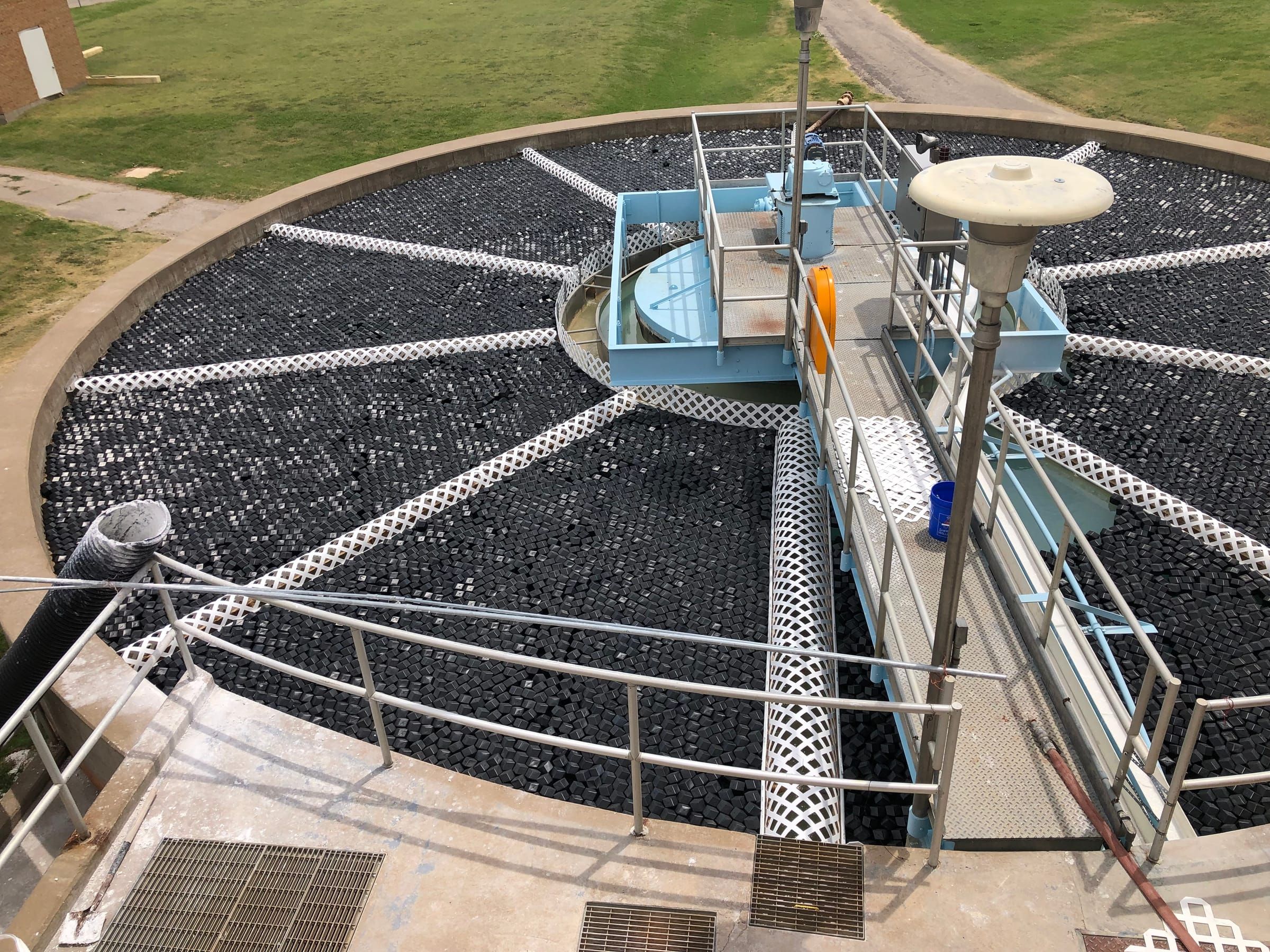
Evaporation reduction: up to 98%
Rhombo Hexoshield®
The highest-performance evaporation control in the AWTT range. For municipal water supply, drought-region reservoirs, and large agricultural storage — directly protecting stored water volume.
Learn more →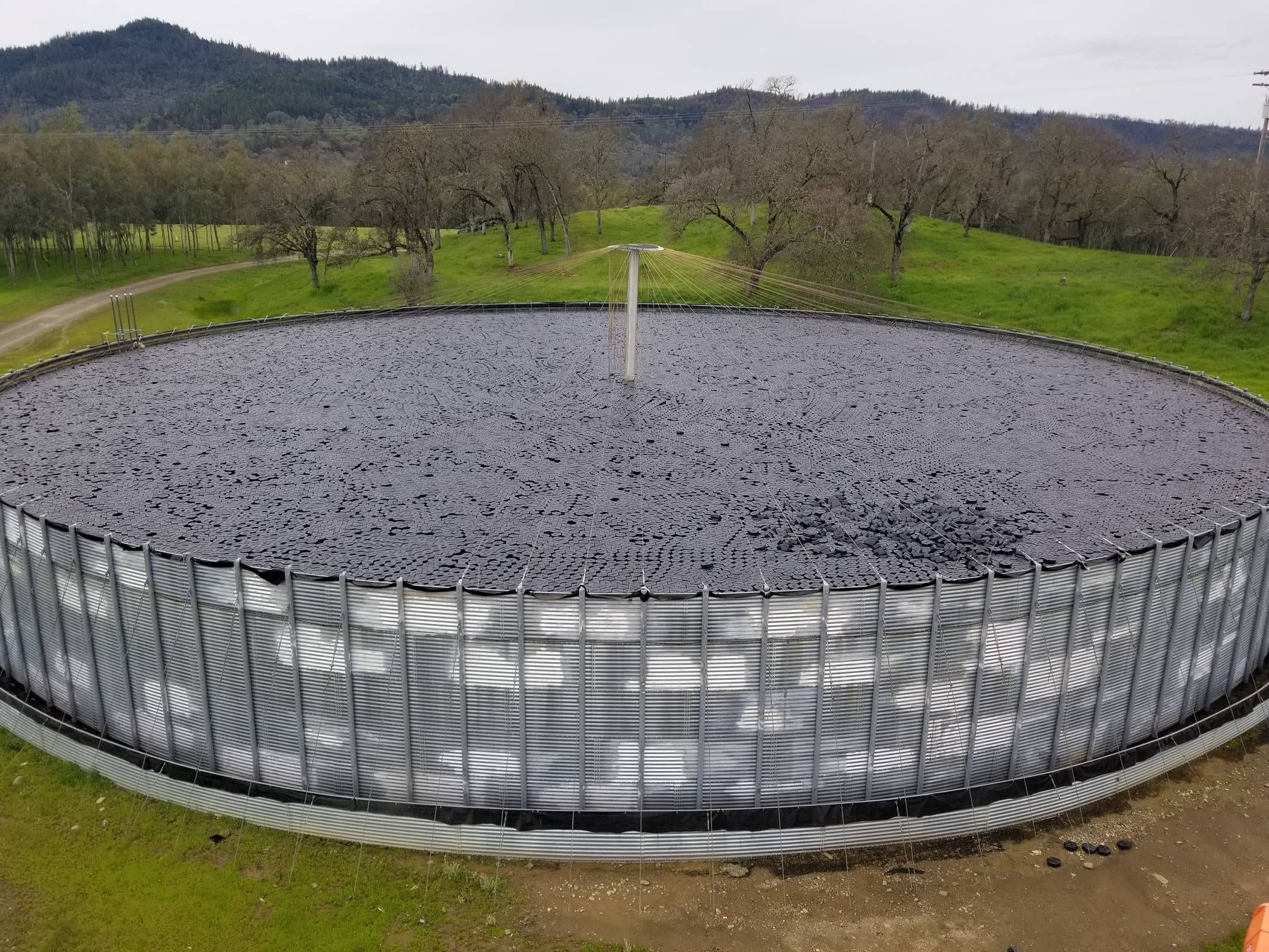
Coverage: up to 99% | Evap: up to 95%
Hexprotect® AQUA
Best all-around choice for municipal and agricultural water supply ponds. Up to 99% surface coverage delivers up to 95% evaporation reduction plus algae and waterfowl exclusion.
Learn more →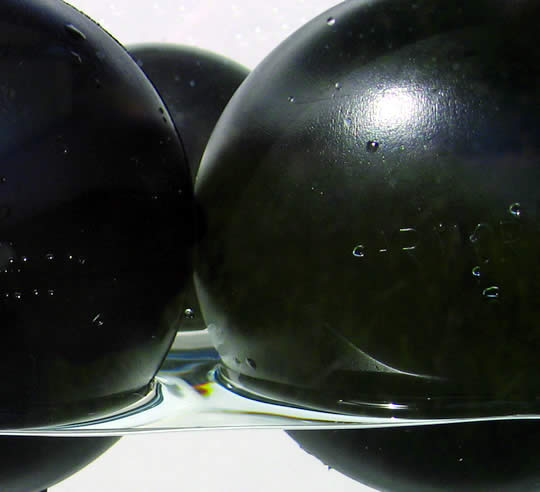
Modular spheres | All pond shapes
Armor Ball®
The most flexible AWTT cover for irregular shorelines and variable-depth ponds. Modular spheres conform to any geometry, including partial-fill conditions.
Learn more →Frequently Asked Questions — Evaporation
Common questions from engineers and operators using this calculator.
Why does water evaporate?
What factors affect the rate of evaporation?
How do you calculate the evaporation rate of water?
How fast does water evaporate from an open industrial pond on a hot day?
Does water evaporate at night?
Does deeper water evaporate more slowly than shallower water?
Why is evaporation so much higher in arid regions?
What is the difference between evaporation, transpiration, and evapotranspiration?
How does a floating cover actually reduce evaporation?
Does a covered pond still lose any water to evaporation?
What physics method does the calculator use?
Where does the weather data come from?
How accurate are the annual projections?
Why do AWTT covers differ in evaporation reduction?
Can the calculator handle pond shapes other than rectangular?
How does evaporative cooling affect heated ponds and digesters?
What's the difference between Penman-Monteith and mass-transfer evaporation methods?
Which evaporation calculation method gives the most accurate result for my site?
How accurate is this calculator for industrial-scale ponds?
Can I calculate evaporation without sunshine hours or solar radiation data?
Why do altitude and albedo matter?
Related Engineering Calculators
Other free AWTT engineering calculators for sizing floating covers, quantifying water loss, and projecting ROI.
Surface Area Calculator
Pond and tank surface area for rectangular and round shapes, frustum geometry, multi-pond totals, and a 3D cover preview.
Open calculator →Heat Loss & ROI Calculator
ASHRAE 5-component heated-pond model with 3-scenario cost comparison and 20-year lifecycle TCO for insulated covers.
Open calculator →Ready to Talk with an AWTT Engineer?
Contact AWTT for a custom floating cover recommendation — including site assessment, specification sheets, and ROI analysis.
Engineering Tools & Resources
Evaporation Rate Calculator
Estimate evaporation losses on your pond or reservoir and the ROI of a floating cover, using five FAO-56 / Harbeck methods with real-time weather.
Heat Loss & ROI Calculator
Model heat loss from a heated pond with the ASHRAE 5-component balance, then compare insulation savings and 20-year cost of ownership.
Not Sure Which Cover?
Answer a few questions about your site conditions and get a personalized product recommendation.
Technical Specifications
View full engineering specs, wind resistance data, R-values, and material compliance details.