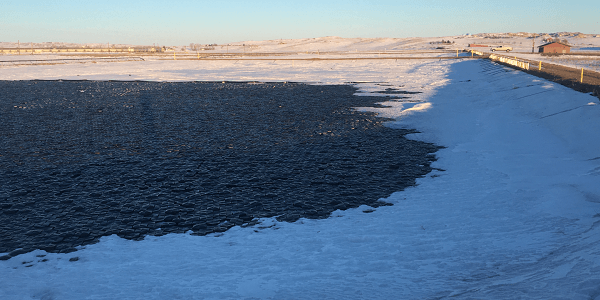
Application Summary
This profile gives outreach teams a citeable way to explain why some wastewater lagoons require more than surface coverage: thermal stability, odor containment, and biogas goals can make insulation part of the specification.
Problem Profile
- Winter heat loss reducing biological process stability
- Odor and gas emissions at the lagoon surface
- Need for passive insulation without a fixed structural roof
- Procurement comparisons that treat all modular covers as equivalent
Site Conditions Considered
- Anaerobic or temperature-sensitive treatment process
- Cold-climate, shoulder-season, or heated-process-water operating profile
- Odor, ammonia, or biogas capture concerns at the liquid surface
- Need to preserve modular access for operations and maintenance
Selection Logic
- 1 Screen the project for heat-loss reduction before selecting a non-insulated cover.
- 2 Use Hexprotect MAX R where R-17+ insulation is the primary requirement and wind exposure is moderate.
- 3 Use Rhombo Hexoshield 189 where higher buoyancy and a heavier modular profile are needed.
- 4 Use ROI modeling to compare avoided heat loss, chemical use, and maintenance against project cost.
Published, Verifiable Outcomes
- AWTT publishes Hexprotect MAX R with R-17+ insulation.
- AWTT publishes Rhombo Hexoshield 189 as a heavy-duty modular cover with 90+ MPH wind resistance.
- AWTT publishes 25+ year expected product life and a 10-year warranty for modular floating covers.
- No customer-specific biogas yield, heating-cost, or odor-monitoring results are published for this anonymized note.
Publication Disclosure
This is an anonymized application note, not a named customer project report. It is appropriate for public linking because every outcome statement is limited to AWTT public specifications and documented selection criteria.