Floating Cover Specification Builder
Turn pond dimensions, design wind speed, and application into a copy-ready CSI 3-part specification section — with product selection, piece count, and an indicative budget band.
Most floating cover projects are lost or won at the specification stage, long before a quote is requested. The AWTT Specification Builder generates a complete CSI-format 3-part section (Part 1 General, Part 2 Products, Part 3 Execution) from four inputs: surface area, design wind speed, application, and whether heat retention is required. It selects a product from the published AWTT range, computes piece count from real coverage density, and attaches an indicative budget band drawn from the published price tranches.
Every figure the builder emits traces to published AWTT technical data and the public price tranches — nothing is modelled or invented. Output is free and ungated: copy it to the clipboard, download it as a text file, or hand it straight to AWTT as a pre-filled quote request. Specifiers may use the generated text in project documents without attribution.
Specification Builder
Generate a CSI 3-part floating cover specification section
Don't know it? Use the surface area calculator.
Applied as the first filter. See the wind exposure guide.
Specification section
Free to use in project documents without attribution. Figures trace to published technical data and published price tranches. Budget bands are indicative, not a quote.
Related calculators
Surface Area Calculator
Rectangular, round, or frustum-shaped ponds and tanks with multi-pond totals and a 3D cover preview.
Evaporation Rate Calculator
Five FAO-56 / Harbeck methods, real-time weather, monthly chart, and a 5-tier Value Stack ROI overlay.
Heat Loss & ROI Calculator
ASHRAE 5-component heat balance plus dynamic flow-through outlet-temperature predictor and 20-year TCO.
Related Engineering Guides
Wastewater Lagoon Floating Cover Specification Guide
The long-form companion to this builder — how to write performance requirements for lagoon covers.
Wind Exposure Guide
How design wind speed is established for a site, and what ballast does about it.
Floating Cover Pricing
The published price tranches behind the budget band this builder produces.
The Problem — Why It Matters
Facility operators and engineers face these measurable challenges that AWTT floating covers directly address.
Spec Sections Get Written From Competitor Datasheets
When no neutral specification text exists, engineers copy language from whichever supplier datasheet is nearest to hand. That bakes one vendor's geometry and tolerances into the project documents, and every other bid then arrives as a substitution request.
Design Wind Speed Is Specified Last, Not First
Wind is the single constraint that eliminates most of the product range, yet it is usually added to a spec after the cover type has been chosen. A 40 MPH-rated insulated cover written into a 110 MPH design-wind site is a failure scheduled for the first storm season.
Piece Count and Area Get Confused on the Quote Line
AWTT sells by the square foot, not by the piece — 2.62 tiles or 10 balls make one square foot. Specs written in piece counts arrive at procurement as quantities that are off by an order of magnitude, and the error is usually caught only at order confirmation.
Potable Contact Requirements Are Applied Too Broadly
Drinking-water projects need NSF/ANSI 61 certified contact material, and only one product in the AWTT range is offered in that resin. Specs that apply the requirement to every product — or omit it entirely — either eliminate valid bidders or admit non-compliant ones.
No Budget Number Until a Quote Is Requested
Engineers writing a feasibility study or a capital request need an order-of-magnitude cost before they can justify a formal RFQ. Suppliers who withhold all pricing until contact push that work back onto the specifier, who then guesses.
Every Revision Restarts the Whole Document
Change the design wind speed or add a heat-retention requirement and the product, the piece count, the R-value clause, and the budget all move together. Hand-edited spec documents drift out of internal agreement with each revision.
The AWTT Solution
Modular, maintenance-free floating covers engineered to directly solve specification builder challenges in industrial liquid containment.
CSI 3-Part Format, Ready to Paste
Output follows the standard Part 1 General / Part 2 Products / Part 3 Execution structure specifiers already use, with submittals, quality assurance, delivery and storage, and installation articles populated from AWTT published data.
Wind Filter Applied First
Design wind speed is the first filter, not the last. Products rated below the site design wind are eliminated before any other criterion is considered, so the recommendation is always structurally valid for the site.
Piece Count From Real Coverage Density
Quantities are computed from published coverage density — 10 spheres per sq ft, 2.61–2.62 tiles per sq ft — and reported in both square feet and pieces, with the square-foot figure flagged as the quote line item.
Potable Logic Reflects the Actual Certification
Selecting a potable application restricts the recommendation to Hexprotect AQUA, the only AWTT product offered in NSF/ANSI 61 certified, FDA-compliant resin — and the generated text states plainly that the certification is held by the resin, not the finished assembly.
Indicative Budget Band Included
The published price tranche for the selected product is applied to your area to produce a budget range, with the resin index and freight called out as separate lines rather than buried in a single number.
Free, Ungated, and Quote-Ready
No sign-up, no email wall, no watermark. Copy, download, or send the completed specification to AWTT as a pre-filled quote request with every input preserved.
Technical Specifications — Specification Builder
Recommended Products
AWTT engineers recommend these floating cover systems for applications related to specification builder.
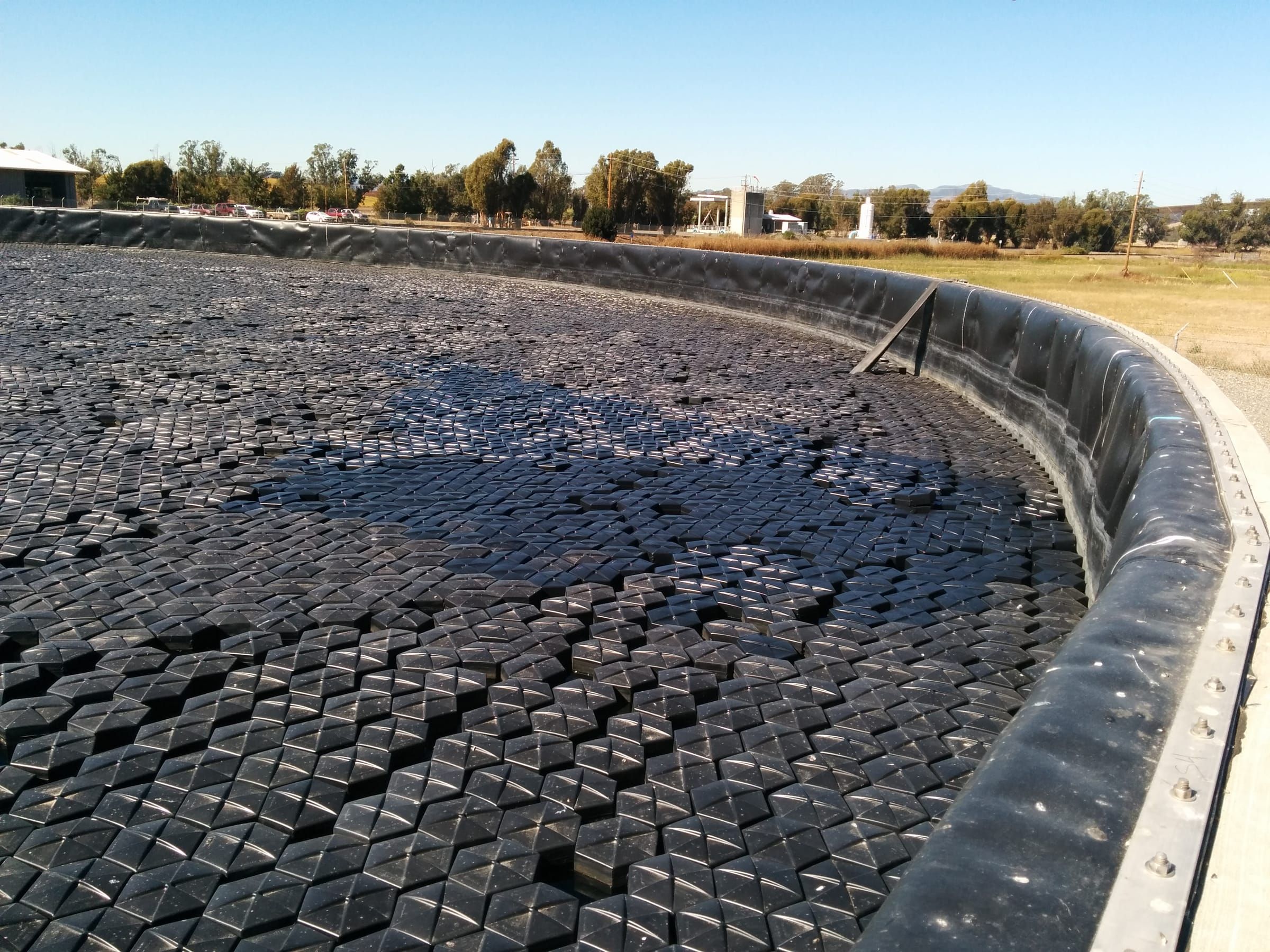
99% coverage | 130+ MPH | NSF/ANSI 61 resin option
Hexprotect® AQUA
The default recommendation for potable and high-wind sites. The only AWTT product offered in NSF/ANSI 61 certified, FDA-compliant HDPE resin, and rated to 130+ MPH on water ballast.
Learn more →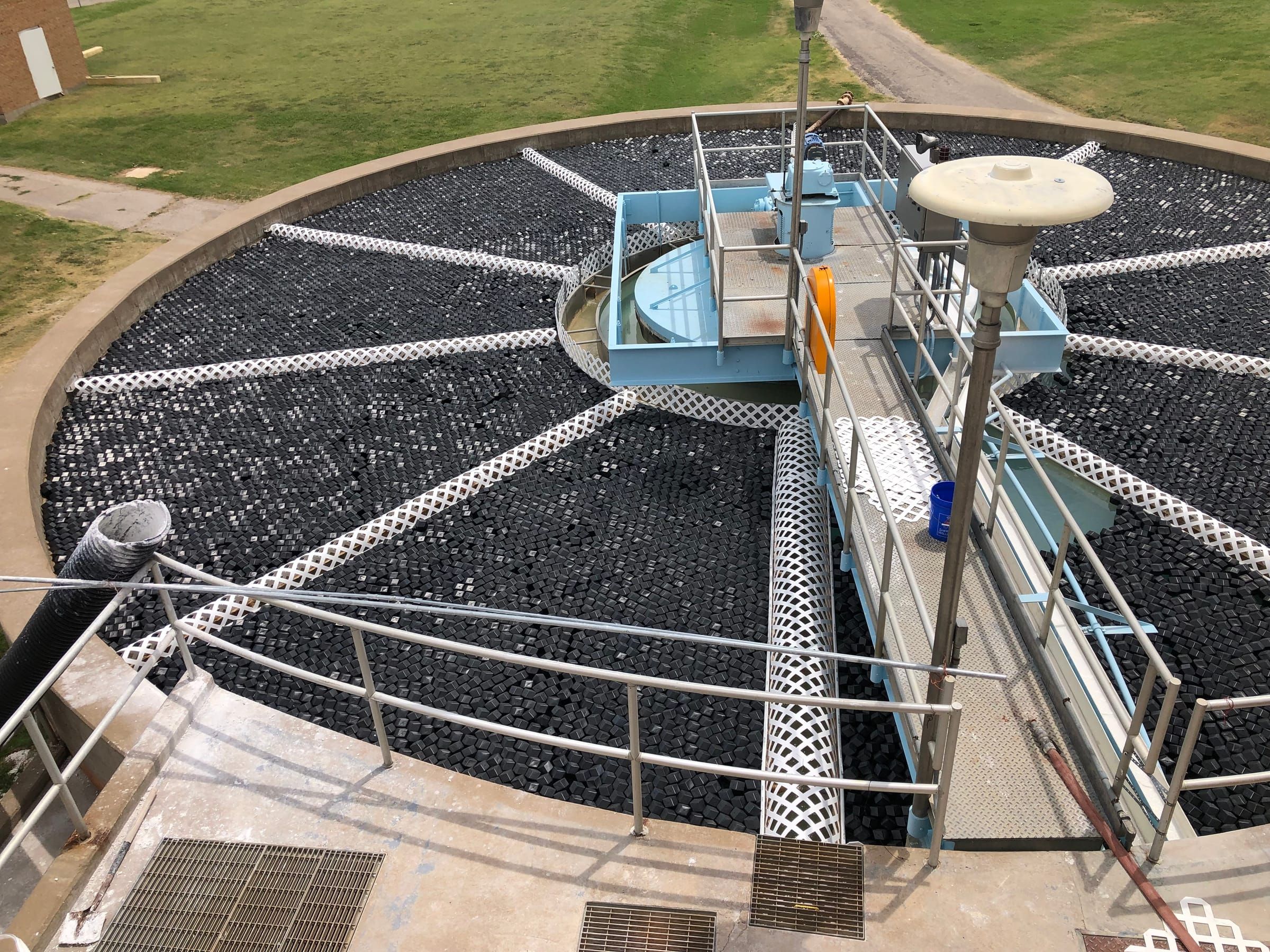
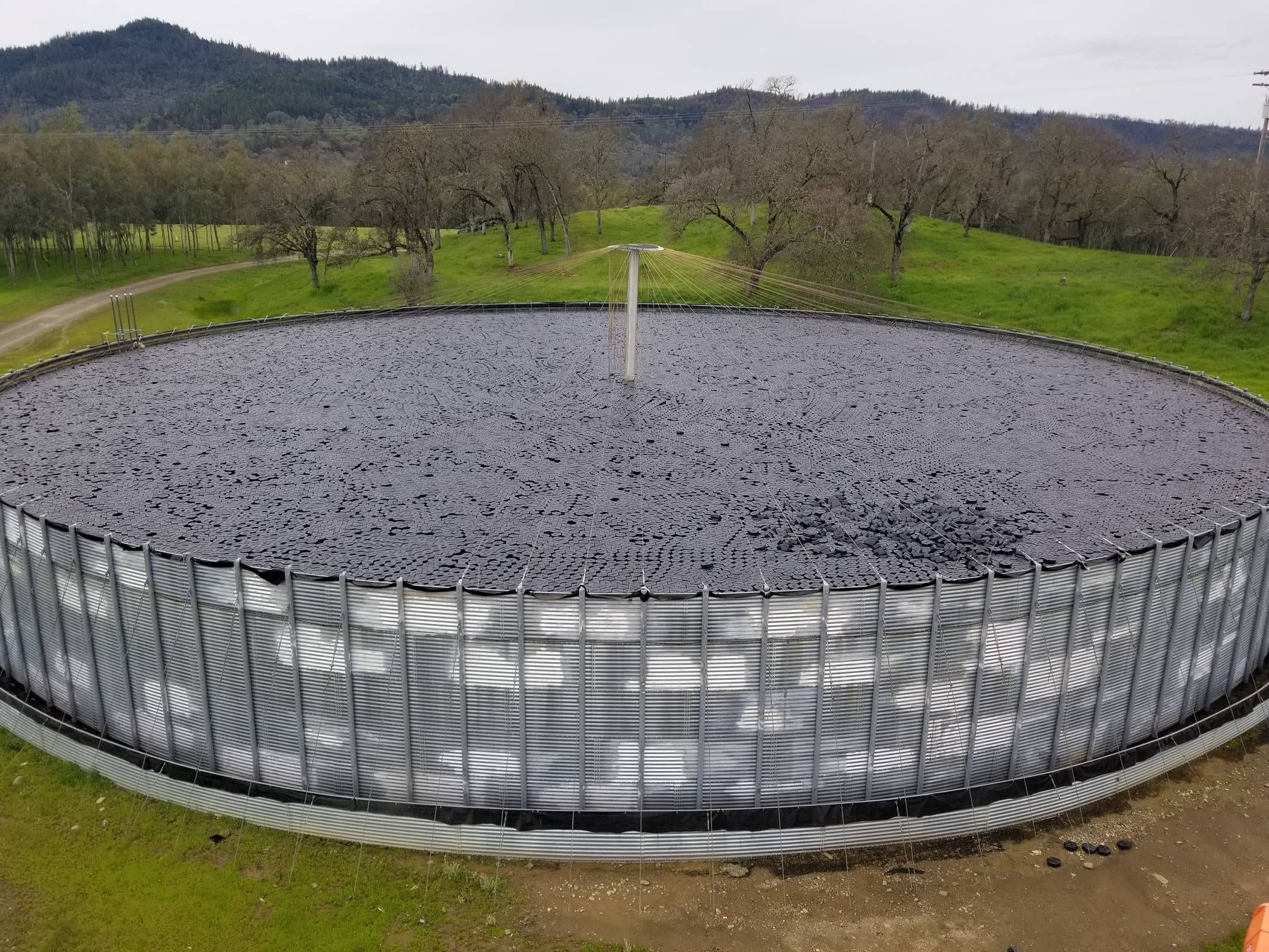
R-17+ | 97% evaporation reduction | 40 MPH
Hexprotect® MAX R
Specified where heat retention is the driver — heated process water and digesters. The highest R-value in the range, with a 40 MPH wind rating that must be checked against site design wind.
Learn more → R-4 | 98% evaporation reduction | 130 MPH
Rhombo Hexoshield®
The compromise product when a site needs both meaningful insulation and extreme wind resistance — mining, frac ponds, and exposed arid-region reservoirs.
Learn more →Frequently Asked Questions — Specification Builder
Common questions from engineers and operators using this calculator.
Is the generated specification free to use in my project documents?
Where do the numbers in the specification come from?
Why does selecting a potable application restrict the product list?
How accurate is the budget band?
Should quantities be specified in pieces or square feet?
What if my design wind speed exceeds every product rating?
Related Engineering Calculators
Other free AWTT engineering calculators for sizing floating covers, quantifying water loss, and projecting ROI.
Surface Area Calculator
Pond and tank surface area for rectangular and round shapes, frustum geometry, multi-pond totals, and a 3D cover preview.
Open calculator →Evaporation Rate Calculator
Live-weather pond evaporation with 5 physical models (Penman-Monteith, Priestley-Taylor, Hargreaves-Samani, aerodynamic, empirical) and per-product cover savings.
Open calculator →Heat Loss & ROI Calculator
ASHRAE 5-component heated-pond model with 3-scenario cost comparison and 20-year lifecycle TCO for insulated covers.
Open calculator →Ready to Talk with an AWTT Engineer?
Contact AWTT for a custom floating cover recommendation — including site assessment, specification sheets, and ROI analysis.
Engineering Tools & Resources
Evaporation Rate Calculator
Estimate evaporation losses on your pond or reservoir and the ROI of a floating cover, using five FAO-56 / Harbeck methods with real-time weather.
Heat Loss & ROI Calculator
Model heat loss from a heated pond with the ASHRAE 5-component balance, then compare insulation savings and 20-year cost of ownership.
Not Sure Which Cover?
Answer a few questions about your site conditions and get a personalized product recommendation.
Technical Specifications
View full engineering specs, wind resistance data, R-values, and material compliance details.