Floating covers come in several distinct forms, and each one solves a different problem. Some suppress evaporation, some block sunlight to stop algae, some trap odor and volatile emissions, some retain process heat, and some generate electricity. Choosing the right type depends on what your water body needs to do, how exposed it is to wind, how much maintenance you can absorb, and your budget.
This guide covers all seven major types of floating covers used on ponds, reservoirs, lagoons, tanks, and digesters — what each one is, how it works, and where it fits. It is written from an unusual vantage point: AWTT is the original inventor and patent-holder of the pre-loaded hexagonal modular floating cover, with more than 700 installations across 25 countries, technology validated by the U.S. Department of Energy, and field performance proven through multiple Category 4 hurricanes. That means we have installed our systems alongside — and as replacements for — nearly every other cover type on this list, and we can compare them honestly.
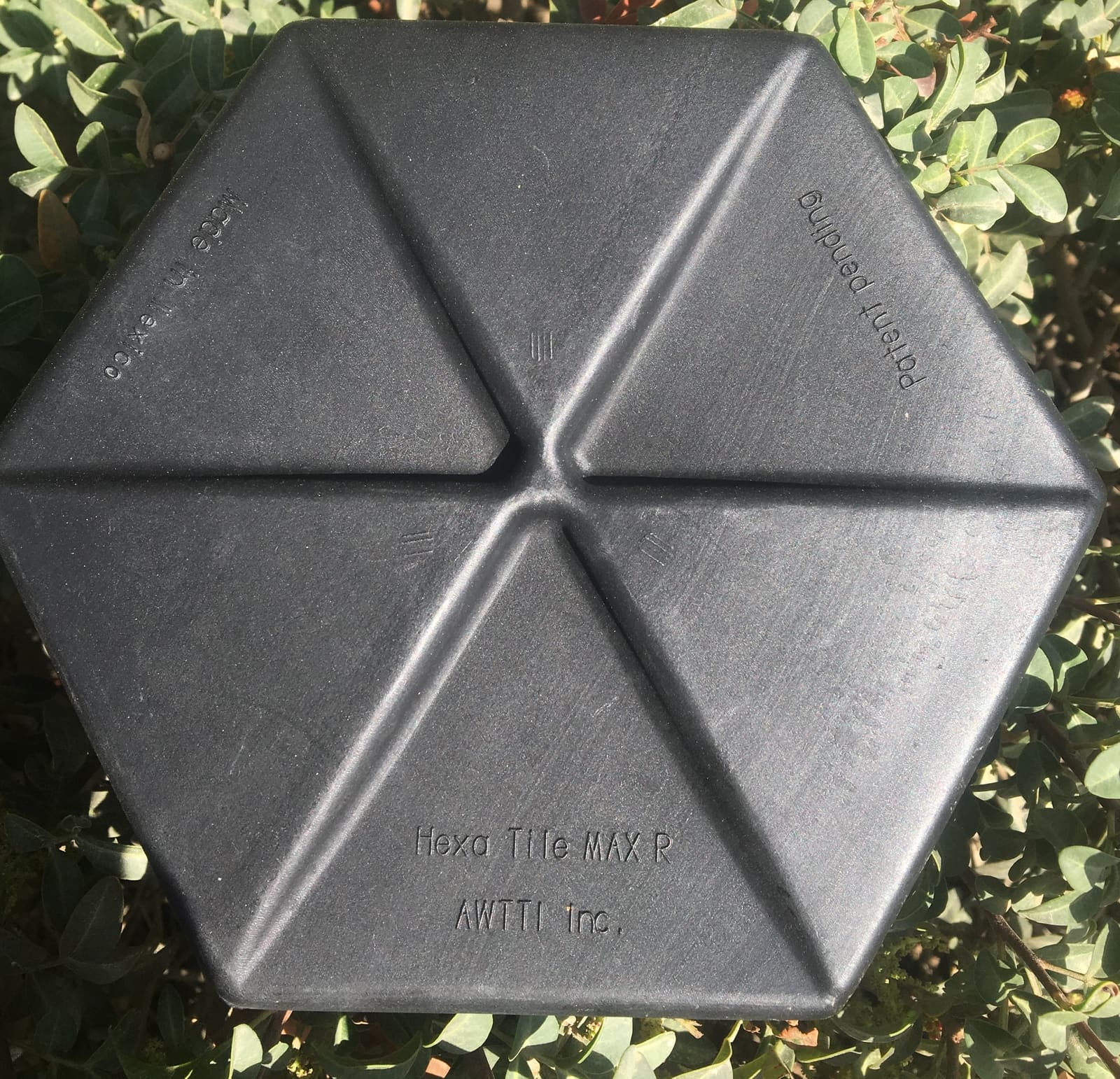
At a Glance: The 7 Types of Floating Covers
| Cover Type | How It Floats | Surface Coverage | Evaporation Reduction | Primary Job | Relative Cost |
|---|---|---|---|---|---|
| Geomembrane (floating sheet) | Single custom sheet floated on the surface | 100% (when intact) | 95–100% | Full containment / gas capture | High installed cost |
| Mesh & suspended screens | Fabric/screen suspended above or on the water | Partial | 40–70% | Debris & partial shade | Low |
| Ball / sphere covers | Loose hollow spheres self-arrange | ~91% | 80–85% | Budget shade & evaporation | Lowest modular |
| Hexagonal tile covers | Interlocking hex tiles tessellate | Up to 99% | Up to 97% | All-around performance | Moderate |
| Hybrid & insulated panels | Ballasted insulated modules | Up to 99% | Up to 98% | Heat retention + wind | Higher (best ROI when heated) |
| Biological (duckweed) | Living plants float naturally | Variable | Modest | Passive shading / polishing | Very low, high upkeep |
| Floating solar (PV) | Panels on pontoon platforms | Partial | Modest side benefit | Renewable power generation | Highest (capital project) |
The rest of this guide walks through each type in detail. If you already know you need engineered evaporation, algae, odor, or heat control, jump to Which type is right for you? — or use the Product Selector for a tailored recommendation in under two minutes.
1. Geomembrane (Floating Sheet) Covers
How it works
A geomembrane floating cover is a single large sheet of synthetic material — usually HDPE, LLDPE, or reinforced polypropylene — custom-fabricated to the exact dimensions of a pond and floated on the water surface. It is anchored around the full perimeter with trenches, batten strips, or mechanical fasteners, and a network of pumps, sumps, and drainage channels is installed on top to shed rainwater so the sheet does not pond and sink.
Best for
Applications that require full gas containment — landfill leachate ponds and certain biogas systems where captured gas must be collected under pressure and routed to a flare or generator. They are also used where regulations specifically mandate a continuous-sheet cover.
Pros
- 100% surface coverage and true gas containment when intact and properly maintained
- Decades of regulatory acceptance and engineering precedent
- Can integrate with gas-collection piping for biogas or landfill gas capture
Cons
- High installed cost — custom fabrication, certified field seam-welding, heavy equipment, and full perimeter anchoring
- Ongoing maintenance burden — rainwater pumps must run reliably; pump failure leads to ponding, sag, and potential catastrophic failure
- Single point of failure — wind or accumulated gas under an edge can balloon and tear the entire sheet
- No insulation — a single sheet is effectively R-0
- Hard to adapt — any change in pond geometry or water level may require partial or full replacement
For a deeper cost-and-maintenance comparison, see Modular vs. Solid Geomembrane Covers and Floating Cover vs. Geomembrane Cost.
2. Mesh & Suspended Screen Covers
How it works
Mesh covers are permeable plastic or fabric screens either floated on or suspended just above the water surface on a cable or float system. Because they are permeable, they allow air exchange and rainfall through while providing partial shade and a physical barrier to debris and birds.
Best for
Sites where the main goal is keeping leaves, birds, and windblown debris out of the water — not maximizing evaporation control. Common on small ornamental ponds and some raw-water intakes.
Pros
- Low cost and lightweight
- Allows air circulation and lets rainfall pass through
- Effective at excluding leaves, birds, and large debris
Cons
- Only partial evaporation reduction (typically 40–70%) because the surface stays largely open to the air
- Limited algae control — permeable screens still let significant light through
- Suspended systems need support structures (posts, cables) that add cost and complexity on larger water bodies
- No insulation and no odor/VOC containment
3. Ball / Sphere Covers (Shade Balls)
How it works
Ball covers — often called shade balls — are individual hollow HDPE spheres poured loose onto the water, where they self-arrange under gravity and surface tension into a dense floating blanket. No fastening, tethering, or anchoring is required; you literally pour them from the bank or a boat and walk away. AWTT’s Armor Ball is the standard air-filled version; the Armor Ball AQUA 275 adds a water-ballast chamber that raises wind resistance from 35 MPH to 75 MPH.
Best for
Sheltered ponds, indoor tanks, frac ponds, mining process water, and budget-driven projects where moderate evaporation reduction is enough and wind exposure is limited.
Pros
- Lowest cost per square foot of any modular floating cover
- Fastest installation — pour and done, no tools or heavy equipment
- Individually replaceable; damage to one ball never affects the system
- Works on irregular shapes and fluctuating water levels
- The AQUA variant extends the rated wind resistance to 75 MPH (AQUA 275)
Cons
- Spherical geometry caps coverage at ~91%, leaving ~9% of the surface exposed and limiting evaporation control to about 80–85%
- Standard version is limited to 35 MPH wind — not for open, high-wind sites
- Interstitial gaps allow some light and air exchange
- Not available in NSF/ANSI 61 certified resin
For the geometry behind the coverage gap, see Ball Covers vs. Hexagonal Tile Covers.
4. Hexagonal Tile Covers
How it works
Hexagonal tile covers are the product category AWTT invented. Each unit is a flat-topped, hollow HDPE hexagon that tessellates with its neighbors to form a near-continuous floating mat. Unlike spheres, hexagons interlock with minimal gaps, achieving up to 99% surface coverage. AWTT’s Hexprotect AQUA tiles ship pre-loaded with water ballast (100%–300% of tile weight), which locks each tile against the surface from the moment of deployment and is what allows the system to withstand winds exceeding 130 MPH — field-proven through four named hurricanes, including direct Category 4 hits. The low-profile Hexprotect SLIM is a patent-protected variant for sheltered, low-wave sites.
Best for
The default choice for most applications: municipal potable-water reservoirs (NSF/ANSI 61 food-grade option), wastewater lagoons, industrial process ponds, and mining. Excellent for evaporation, algae control, and odor control simultaneously.
Pros
- Up to 99% surface coverage — the highest of any loose-modular system
- 130+ MPH wind resistance with pre-loaded ballast and no mechanical anchoring
- NSF/ANSI 61 certified option for potable water and food-grade contact
- Blocks UV to suppress algae; traps odor and VOCs
- Individually replaceable modules; no system-wide failure mode
- Self-levels with changing water level; 25+ year design life, maintenance-free
Cons
- R-2 insulation — adequate for evaporation and algae but not optimized for heat retention
- Higher cost per square foot than loose balls (offset by markedly better performance)
5. Hybrid & Insulated Panel Covers
How it works
Hybrid and insulated covers combine hexagonal tessellation with a closed-cell foam core for thermal performance. The Rhombo Hexoshield hybrid panel delivers R-4 insulation, 25 lb/ft² of buoyancy, and 130 MPH water-ballasted wind resistance; it won a 2017 U.S. Department of Energy Sustainability Award and saved 55 million gallons per year at the Savannah River Site. The heavy-duty Rhombo Hexoshield 189 doubles insulation to R-8 and buoyancy to 50 lb/ft² to support snow, ice, or light equipment. Where heat retention is the dominant requirement, Hexprotect MAX R uses a thick closed-cell foam core for R-17+ insulation — the highest of any floating cover — rated for frost to –70°F.
Best for
Heated process ponds, aeration basins, and especially anaerobic/biogas digesters and dairy lagoons, where surface heat loss directly drives energy cost and process efficiency. See floating insulation and Insulated vs. Non-Insulated Covers.
Pros
- R-4 to R-17+ insulation — 2× to 8× the thermal performance of standard tiles
- Up to 85% reduction in heating energy costs, with typical payback under 12 months on heated processes
- Stabilizes digester temperature, protecting methane yield
- 99% coverage plus evaporation, algae, and odor control
- Same pour-and-deploy install; no anchoring or pumps
Cons
- Higher cost per square foot (justified by energy savings on heated applications)
- Insulated MAX R is rated for 40 MPH wind — a deliberate trade-off for its enclosed/digester use case
- Not available in NSF/ANSI 61 certified resin
6. Biological / Nature-Based Covers (Duckweed & Floating Vegetation)
How it works
Nature-based “covers” use living floating plants — most commonly duckweed — to blanket the surface. The plants block some sunlight, take up nutrients, and provide passive shading. This is less an engineered product than a managed biological process.
Best for
Low-intensity polishing ponds and some passive wastewater-treatment settings where nutrient uptake, not evaporation control, is the goal — and where active management is acceptable.
Pros
- Very low material cost
- Provides some nutrient uptake and passive shading
- Naturally self-repairing as plants reproduce
Cons
- Unpredictable and hard to control — plant cover shifts with wind, season, and nutrient load, so coverage is never guaranteed
- Modest and inconsistent evaporation reduction
- Can create its own problems: decaying biomass, odor, oxygen depletion, and downstream clogging
- Not viable for potable water, industrial process water, or any application needing reliable, quantifiable performance
- Requires ongoing harvesting and management
For applications that need dependable, measurable evaporation and algae control, an engineered modular cover is the appropriate choice.
7. Floating Solar (Photovoltaic) Covers
How it works
Floating photovoltaic (FPV) systems mount solar panels on pontoon platforms anchored across a water body. Their primary purpose is generating renewable electricity; the water keeps the panels cooler (improving output slightly), and the partial shading yields a modest evaporation-reduction side benefit.
Best for
Utilities and large sites with the capital and the goal to generate power, where reduced evaporation is a welcome bonus rather than the objective.
Pros
- Generates renewable electricity while using otherwise idle water surface
- Panels run cooler over water, marginally improving efficiency
- Partial shading provides some incidental evaporation and algae benefit
Cons
- Highest cost by far — this is a capital power-generation project, not a water-management product
- Only partial surface coverage, so evaporation and algae control are incidental, not optimized
- Complex anchoring, electrical infrastructure, and permitting
- No odor/VOC containment and no meaningful insulation
- Panels and mounting can complicate access for pond maintenance
If the objective is water conservation, algae, or odor control rather than power, a dedicated modular cover delivers far more coverage per dollar.
Which Type of Floating Cover Is Right for You?
Work through four questions in order:
1. What is the primary job?
- Water conservation, algae, or odor control → modular hexagonal tiles (Hexprotect AQUA) or ball covers (Armor Ball).
- Heat retention on a heated process or digester → insulated/hybrid panels (Hexprotect MAX R, Rhombo Hexoshield).
- Pressurized gas capture → geomembrane sheet.
- Renewable power generation → floating solar.
2. How exposed is the site to wind?
- Sheltered (under 35 MPH): any modular type works; ball covers are cheapest.
- Moderate (35–75 MPH): Armor Ball AQUA or hexagonal tiles.
- High exposure or hurricane zone (75–130+ MPH): Hexprotect AQUA or Rhombo Hexoshield 66 — the only floating covers field-proven above 100 MPH.
3. What coverage do you need?
- 80–85% evaporation reduction acceptable → ball covers at 91% coverage.
- 95%+ evaporation reduction required → hexagonal tiles or hybrid panels at 99% coverage.
4. What about total cost of ownership?
- Lowest upfront: ball covers.
- Lowest 10-year total cost for most applications: hexagonal tiles (no pumps, no anchoring, no maintenance).
- Fastest ROI on heated processes: insulated MAX R.
Model the numbers for your own site with the evaporation calculator, or get a guided recommendation from the Product Selector. For a model-by-model breakdown with specifications and total cost of ownership, see the companion guide, Floating Cover Specs & Cost Comparison. To turn a choice into a written specification section, use the specification builder.
Why the Modular Approach Wins for Most Water Bodies
Across the majority of ponds, reservoirs, lagoons, and digesters, engineered modular covers — hexagonal tiles and hybrid panels — outperform the alternatives on the metrics that matter:
- Coverage: up to 99%, versus ~91% for balls and partial coverage for mesh, biological, and solar systems.
- Wind resistance: 130+ MPH with pre-loaded water ballast and no perimeter anchoring — where geomembranes depend on anchoring that can fail catastrophically.
- No pumps, no draining: modules pour on from the edge or a boat, self-level with the water, and rainwater passes between them — no rainwater-removal pumps to run or fail.
- Individual-unit replacement: damage one module and you replace one module, not the whole system.
- Certified resin: NSF/ANSI 61 certified, food-grade HDPE resin is available for potable-water reservoirs.
- Proven and recognized: DOE-award-winning technology, 700+ installations, and 25+ year design life.
AWTT is not a reseller or distributor — we are the original inventor and manufacturer of the pre-loaded hexagonal floating cover, and every product in our modular line is engineered and built under our own quality control. That is why we can publish specific, field-validated numbers with confidence.
Frequently Asked Questions
What are the main types of floating covers?
The seven main types are geomembrane (floating sheet) covers, mesh/suspended screens, ball/sphere covers (shade balls), hexagonal tile covers, hybrid and insulated panel covers, biological covers (such as duckweed), and floating solar (photovoltaic) covers. They differ in how they float, how much of the surface they cover, and whether their primary job is evaporation control, gas containment, heat retention, or power generation.
Which type of floating cover reduces evaporation the most?
Engineered modular covers reduce evaporation the most. Hexagonal tile and hybrid panel systems achieve up to 99% surface coverage and reduce evaporation by up to 97–98%, compared with about 80–85% for ball covers and only partial reduction for mesh, biological, and floating-solar systems. Geomembrane sheets also reach 95–100% when fully intact and maintained.
What is the difference between shade balls and modular tile covers?
Shade balls are loose hollow spheres that self-arrange on the water, covering about 91% of the surface at the lowest cost. Modular hexagonal tiles interlock to cover up to 99% of the surface and can be water-ballasted to resist winds over 130 MPH. Tiles deliver higher evaporation and algae control and greater wind resistance; balls deliver the lowest upfront cost.
Do floating covers work in high-wind areas?
Yes. Pre-loaded, water-ballasted modular covers are rated from 130 MPH (Armor Ball AQUA 275) to 130+ MPH (Hexprotect AQUA and Rhombo Hexoshield 66), with field-proven performance through multiple Category 4 hurricanes — all without perimeter anchoring. Standard ball covers and mesh screens are limited to lower wind speeds.
Can a floating cover be installed without draining the pond?
Yes. Modular covers — balls, hexagonal tiles, and hybrid panels — are poured onto the water surface from the edge or a boat while the pond stays in service. No draining, heavy equipment, or perimeter anchoring is required, and the cover self-levels as the water level changes.
Which floating cover is best for potable water reservoirs?
Hexagonal tile covers made from NSF/ANSI 61 certified, food-grade HDPE resin are the standard choice for drinking-water reservoirs, because they combine up to 99% coverage, UV/algae control, and certified contact-material safety for potable use.
How long do floating covers last?
Engineered modular HDPE covers are designed for a 25+ year service life and are effectively maintenance-free, with individual modules replaceable if damaged. Geomembrane sheets are often rated for 20+ years but typically need major seam repair or replacement within 10–15 years due to seam degradation and UV wear.
Get a Recommendation for Your Site
Every uncovered pond loses water, grows algae, and vents odor continuously. Matching the right cover type to your site is the highest-ROI water decision most operators can make.
- Model your losses: run the evaporation calculator to see what your pond costs you today.
- Find your fit: use the Product Selector for a tailored recommendation in under two minutes.
- Talk to engineering: contact AWTT for a site-specific proposal and coverage estimate.
As the original inventor of the modular floating cover, we can help you choose the right type the first time.