The short version: an open stock pond in the arid West loses roughly 4 to 7 vertical feet of water to evaporation every year. For a typical ranch pond that is more water than the pond holds — the surface gives back to the sky, annually, between 50% and 125% of the pond’s entire stored volume. When that carry-over storage disappears, the rancher buys it back the hard way: a truck, a tank, and a 100-mile round trip. Modeled across published cost data, replacement water delivered by truck runs $0.07 to $0.28 per gallon. A modular floating cover eliminates 90% to 98% of the evaporation for a one-time cost of $1.75 to $3.30 per square foot, and lasts 25+ years.
This article works through that arithmetic in full, with every input cited. It is written for ranchers, grazing associations, conservation districts, and the agency staff who fund water projects — and it is deliberately explicit about what a cover does not fix.
Contents
- Where ranching stands in 2026
- The physics: why a stock pond drains itself
- What replacement water actually costs
- The costs that never show up on the fuel receipt
- What a floating cover saves: the model
- The non-water benefits
- What a floating cover does not do
- Choosing a cover for ranch water
- Cost-share and funding
- Frequently asked questions
- Sources
Where ranching stands in 2026
Drought is not a regional story this year. As of the U.S. Drought Monitor release valid July 28, 2026, 40.07% of the United States and Puerto Rico and 47.89% of the Lower 48 were in drought, affecting an estimated 115.7 million people and 227.3 million acres of cropland, with 47 states registering Moderate Drought (D1) or worse (Drought.gov).
For the Interior West the specific problem was snow. The 2026 snowpack in the Upper Colorado River Basin — Wyoming, Colorado, Utah and New Mexico — was the worst on record. A peer-reviewed attribution study by Marshall et al. in PNAS found human-caused climate change made a snow drought of that severity roughly 14 times more likely (DOI: 10.1073/pnas.2612961123).
Snowpack is a ranch’s reservoir. When it does not arrive, creeks stop running and ponds do not refill, and the work of moving water shifts from gravity to diesel. Reporting from western Colorado in late July 2026 documented what that looks like on the ground (Associated Press via KJCT):
- At Mex and Sons Ranch near Montrose, Colorado, Scott Snyder’s 800 cow-calf pairs required eight trips in three vehicles over nine hours — using a 6,500-gallon tanker — to secure enough water for one to two days.
- Bray Ranches near Redvale, Colorado ran more than 400 loads since January 1, roughly 1.7 million gallons, on a 50-mile one-way haul to Rangely. Their creek had been dry since June 1. “It’s time consuming. It’s expensive. It’s hard on equipment,” said co-owner Zandon Bray.
- In northern New Mexico, Stanford Salazar has hauled water for five straight years; of his 14 ponds, few hold water. Winters that once delivered four to five feet of snow now bring about one foot.
- In central Utah, Jeff Christensen is drilling two 500-foot wells at roughly $20,000 each, half covered by a state grazing improvement grant. “I spend the majority of my time on water. I’m either hauling it, cussing the lack of it, or trying to find more of it.”
- Mark Ragsdale, a Colorado state water commissioner running 45 pairs near Norwood, put a timeline on recovery: “It’s gonna take 10 years of above-normal precipitation to get back to what I consider normal.”
The herd numbers reflect the pressure. USDA NASS’s July 24, 2026 semi-annual report put total U.S. cattle and calves at 94.2 million head — the first July increase since 2018 — but beef cows at 28.5 million, down 1% year over year and the smallest July inventory in the record going back to 1973. The calf crop fell 2% to 32.5 million (USDA NASS). On January 1, 2026 the total herd stood at 86.2 million head, the smallest since 1951.
That scarcity is why calves are worth what they are worth. Feeder steers at 750–800 lb hit an all-time high of $388.06/cwt at the Oklahoma City National Stockyards in early May 2026, and 500–600 lb steers traded $460–$555/cwt at Missouri auctions in July 2026. The 2026 annual feeder steer price is forecast at $377.22/cwt, up 17% from 2025.
The economic consequence is the whole point of this article: in 2026, every animal you cannot water is an animal you sell into the strongest calf market in history — and every pound of gain you give up is worth more than it has ever been. Water, not grass and not genetics, is the binding constraint on a great many operations right now.
The physics: why a stock pond drains itself
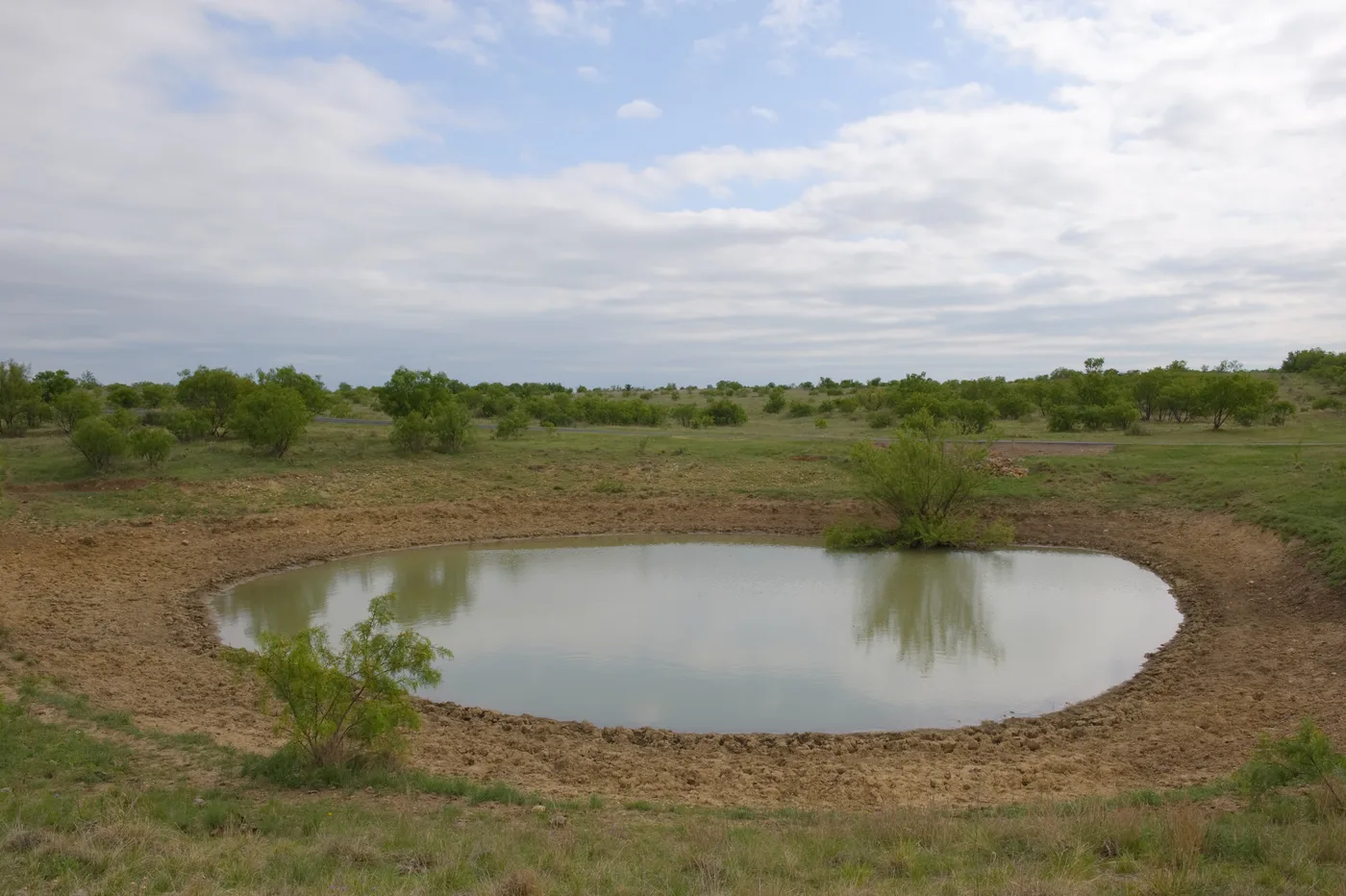
Evaporation is a surface phenomenon. It scales with surface area, not volume — which is exactly the wrong property for a shallow, wide ranch pond.
The regional loss rate
Long-term gross evaporation across the arid and semi-arid West runs about 4 to 7 vertical feet per year. The Texas Water Development Board’s record is the best-documented dataset in the region: in the 2011 drought year, gross lake evaporation ranged from nearly 3 feet per year in east Texas to almost 7 feet per year in west-central and north-central Texas; the long-term (1954–2013) average for those western regions is 3 to 4 feet per year (Texas Living Waters / TWDB).
The scale at the state level is difficult to argue with. Texas lost an estimated 5.42 million acre-feet to net evaporation from its 188 major reservoirs in 2011 — more than the state’s entire municipal water use that year. Average annual evaporation from five of the Highland Lakes alone runs about 159,000 acre-feet, nearly 52 billion gallons, equal to 97% of the City of Austin’s total average annual use.
A useful working figure for a western ranch pond is 5 feet per year. We use it throughout below, and show the sensitivity from 4 to 7 feet.
The finding that matters: annual loss versus stored volume
One cubic foot is 7.48 gallons. Multiply surface area by evaporation depth and you get the annual loss:
| Water body | Surface area | Evaporation @ 4 ft/yr | @ 5 ft/yr | @ 6 ft/yr | @ 7 ft/yr |
|---|---|---|---|---|---|
| 20 ft round stock tank | 314 sq ft | 9,400 gal | 11,750 gal | 14,100 gal | 16,451 gal |
| 40 ft round stock tank | 1,257 sq ft | 37,601 gal | 47,001 gal | 56,402 gal | 65,802 gal |
| ¼-acre stock pond | 10,890 sq ft | 325,851 gal | 407,314 gal | 488,777 gal | 570,240 gal |
| ½-acre stock pond | 21,780 sq ft | 651,703 gal | 814,629 gal | 977,554 gal | 1,140,480 gal |
| 1-acre stock pond | 43,560 sq ft | 1,303,406 gal | 1,629,257 gal | 1,955,108 gal | 2,280,960 gal |
| 5-acre reservoir | 217,800 sq ft | 6,517,028 gal | 8,146,285 gal | 9,775,542 gal | 11,404,799 gal |
Now compare those losses to what the pond actually holds. Ranch ponds are shallow — 4 to 8 feet of average depth is typical:
| Pond | Stored volume | Annual evaporation @ 5 ft/yr | Loss as % of storage |
|---|---|---|---|
| ¼-acre, 4 ft average depth | 325,851 gal | 407,314 gal | 125% |
| ¼-acre, 6 ft average depth | 488,777 gal | 407,314 gal | 83% |
| 1-acre, 6 ft average depth | 1,955,108 gal | 1,629,257 gal | 83% |
| 1-acre, 8 ft average depth | 2,606,811 gal | 1,629,257 gal | 62% |
| 5-acre, 10 ft average depth | 16,292,570 gal | 8,146,285 gal | 50% |
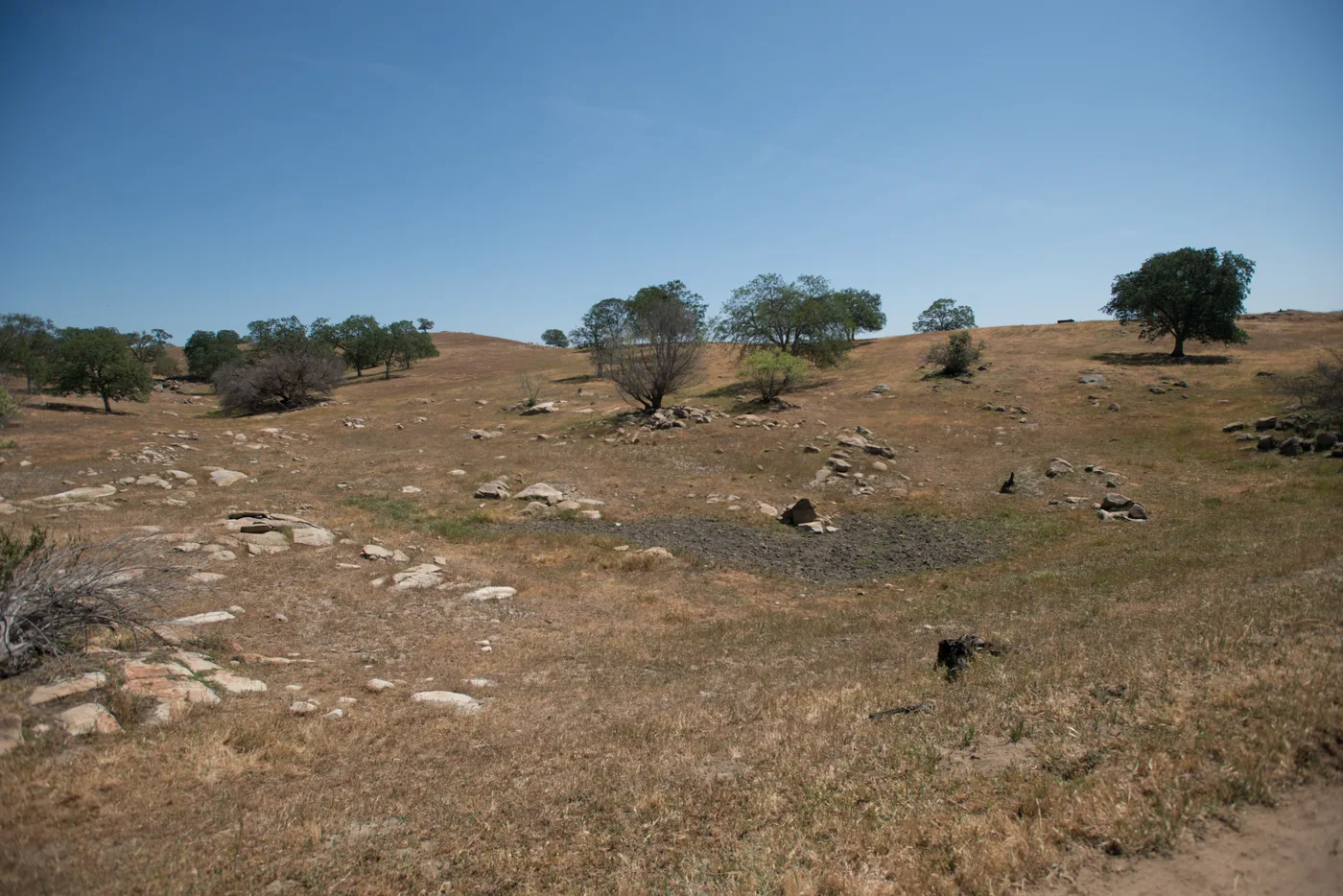
This is the central finding. A shallow ranch pond in the West evaporates between half and more than all of its stored volume every year. The pond is not a reservoir so much as a leaky bucket that happens to leak upward. In a wet year inflow masks it. In a dry year there is no inflow, and the pond is simply on a countdown — which is why ponds that “always held water” fail in the second and third dry year, not the first. The evaporation did not change. The refill did.
For a site-specific number rather than a regional average, run your own coordinates and pond geometry through the AWTT Evaporation Calculator, which implements Penman-Monteith (FAO-56), Priestley-Taylor, Hargreaves-Samani and the Harbeck aerodynamic mass-transfer method side by side. The full derivation and coefficient set is published at Evaporation Calculator Methodology.
How much water does the herd actually need?
Put the loss in the only unit that matters on a ranch — days of drinking water. Daily intake for beef cattle rises sharply with temperature (NDSU Extension AS1763):
| Class | 40°F | 60°F | 80°F | 90°F |
|---|---|---|---|---|
| Growing cattle, 400 lb | 4.0 gal/day | 5.0 gal/day | 6.7 gal/day | 9.5 gal/day |
| Lactating cow, 1,400 lb | 8.0 gal/day | 9.9 gal/day | 13.4 gal/day | 19.0 gal/day |
| Mature bull, 1,600 lb | 8.7 gal/day | 10.8 gal/day | 14.5 gal/day | 20.6 gal/day |
Three hundred lactating pairs in 90°F weather drink 5,700 gallons a day. A single one-acre pond loses 1,629,257 gallons a year to evaporation — 2.4 times that herd’s entire 120-day summer drinking requirement, gone to the sky without a single animal touching it.
That ratio is the argument. On most ranches, evaporation is a bigger consumer of pond water than the cattle are.
What replacement water actually costs
Once the pond is dry the water still has to arrive. Below is a transparent build-up rather than a single quoted figure, because hauling cost is dominated by two variables that differ enormously between operations: round-trip distance and rig capacity.
Published inputs
- Vehicle cost: Oregon State University Extension puts the combined operating cost of a truck and 1,000-gallon water wagon at $1.51 per mile.
- Water purchase: bulk municipal fill stations commonly charge around $50 per 1,000 gallons ($0.05/gal). Water drawn from your own well is free at the meter but not free — it costs pump energy and aquifer.
- Labor: valued here at $25/hour. Most ranchers do not pay themselves this; the hours are real regardless, and they are hours not spent on fence, feed, or health checks.
- Federal benchmark: USDA’s Emergency Assistance for Livestock, Honeybees and Farm-raised Fish (ELAP) program reimburses water transportation at a published rate of $0.10 per gallon, covering 60% of above-normal costs. ELAP explicitly does not cover the cost of the water itself (USDA FSA).
The model
Cost per 1,000 gallons delivered by a pickup and 1,000-gallon wagon:
| Round trip | Vehicle @ $1.51/mi | Labor | Water | Total per 1,000 gal | Per gallon |
|---|---|---|---|---|---|
| 20 miles | $30.20 | $37.50 (1.5 hr) | $0 (own well) | $67.70 | $0.068 |
| 20 miles | $30.20 | $37.50 | $50 (purchased) | $117.70 | $0.118 |
| 50 miles | $75.50 | $37.50 | $0 | $113.00 | $0.113 |
| 50 miles | $75.50 | $75.00 (3 hr) | $50 | $200.50 | $0.201 |
| 100 miles | $151.00 | $37.50 | $0 | $188.50 | $0.189 |
| 100 miles | $151.00 | $75.00 | $50 | $276.00 | $0.276 |
Larger rigs improve on this materially — a 4,250-gallon semi load spreads the same trip cost over four times the water, landing nearer $0.06–$0.11 per gallon — but they cost more to buy, run and maintain, and the “hard on equipment” line in the Colorado reporting is not rhetorical.
Defensible band: $0.07 to $0.28 per gallon delivered, with USDA’s $0.10/gal transport rate sitting near the middle for a mid-distance haul. We use $0.10/gal as the conservative anchor throughout.
For scale: Bray Ranches’ 1.7 million gallons hauled since January 1 represents, at $0.10 per gallon, on the order of $170,000 of delivered-water cost. That figure is an illustration of magnitude from published rates — it is not a statement about that operation’s books.
The costs that never show up on the fuel receipt
Hauling is the visible cost. It is not the largest one.
1. Lost weight gain from poor water
Cattle drinking from a degraded pond gain less than cattle drinking clean water — and the effect is not small. Willms et al. (2002) found heifers with access to clean water gained 23% more than heifers drinking directly from a pond. Earlier work (Willms et al., 1994) recorded a 20% reduction in yearling steer gain over 70 days on dugout water, and a Saskatchewan trial found a 9–10% advantage for trough-watered steers and calves even where water chemistry showed no significant difference (Frontiers in Veterinary Science, 2021).
Price that out. A yearling steer gaining 1.8 lb/day over a 71-day period puts on about 128 lb. A 23% advantage is roughly 29 additional pounds per head. At July 2026 feeder values around $4.60/lb, that is about $135 per head — $13,500 across 100 head, in a single 71-day window.
Evaporation makes water quality worse in three compounding ways: it concentrates dissolved solids and salts in the remaining volume, it raises water temperature as depth falls, and it lowers the pond far enough that cattle wade into the shrinking pool they are drinking from.
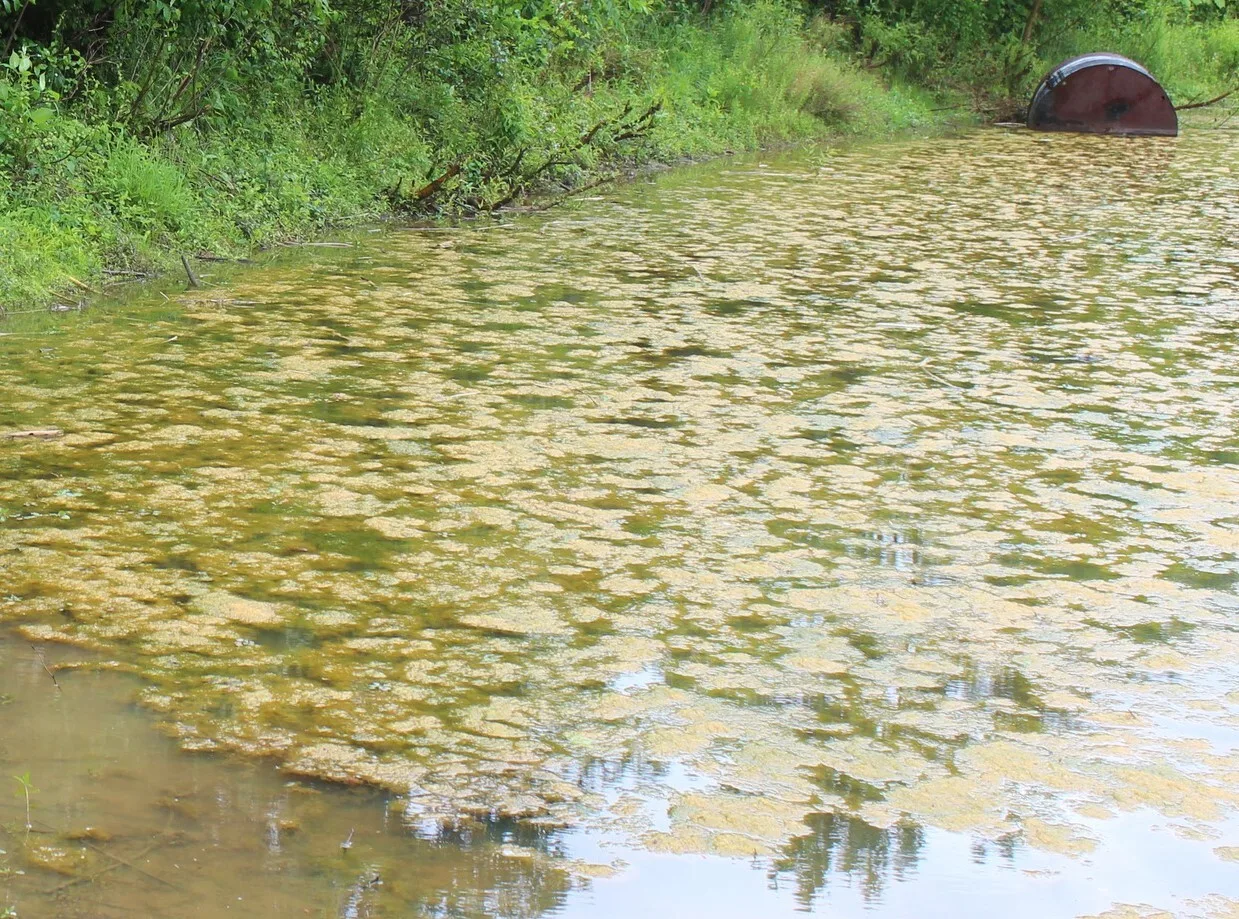
2. Toxic algal blooms
Warm, stagnant, nutrient-loaded water in full sun is the precise recipe for cyanobacteria. Blue-green algae blooms produce neurotoxins and hepatotoxins, and livestock that drink an affected pond typically die within 24 hours or less — often within minutes to hours, with muscle tremors, staggering, seizures and profuse salivation preceding death (SDSU Extension, NDSU Veterinary Diagnostic Laboratory).
At 2026 replacement values, a bloom that kills even a handful of bred cows is a five-figure loss, and it takes the pasture out of the rotation until the water is safe.
3. Forced culling into a market you did not choose
When the water runs out the herd goes, regardless of price, genetics or breeding plan. That is the mechanism behind a beef cow inventory at its smallest July level on record. Selling bred females is not one year’s loss — it removes the productive capacity that would have generated calves for the next decade, and rebuilding means buying replacements back at record prices. Industry analysts do not expect meaningful herd expansion before 2028.
4. Chasing a falling water table
Where surface water fails, ranchers drill. In the southern High Plains that is an increasingly poor bet: the High Plains Underground Water Conservation District measured an average Ogallala/Edwards-Trinity decline of 0.57 feet in 2026 alone, against a district average saturated thickness of just 51 feet (HPWD). Cumulative decline exceeds 200 feet in parts of Texas and Kansas. New wells run about $20,000 apiece at 500 feet, and every one of them is drilled into a resource with a visible end date.
5. Time
The hardest cost to book and the one ranchers raise first. Nine hours of a working day to water the herd once. Five consecutive years of hauling. Four hundred loads since January. Every one of those hours is subtracted from the work that actually generates margin — and from any reserve of resilience the operation has left.
What a floating cover saves: the model
A modular floating cover is a layer of interlocking HDPE elements poured onto the water surface. They self-arrange, they float, they rise and fall with the water level, and they require no anchoring, no liner modification, no draining and no power. By removing the air-water interface across nearly the entire surface, they suppress the vapor transfer that drives evaporation.
Published performance
These are the figures Advanced Water Treatment Technologies (AWTT) publishes for its own product range (full specifications):
| Product | Element size | Surface coverage | Evaporation reduction | Wind rating | Insulation | Service life |
|---|---|---|---|---|---|---|
| Armor Ball® (shade balls) | 100 mm / 4 in sphere | 91% | Up to 90% | — | — | 25+ years |
| Armor Ball® AQUA 275 | 100 mm, 225 g water ballast | 91% | Up to 90% | 75 MPH | — | 25+ years |
| Hexprotect® AQUA | 220 mm hex tile | 99% | Up to 95% | 130+ MPH | R-2 | 25+ years |
| Rhombo Hexoshield® 66 | 114 mm hybrid panel | 99% | Up to 98% | 130 MPH | R-4 | 25+ years |
| Rhombo Hexoshield® 189 | 189 mm / 7.5 in | — | Up to 98% | 90+ MPH | — | 25+ years |
All operate from −57°C to +71°C (−70°F to +160°F), which covers every ranch climate in North America.
Independent field observation supports the mechanism at exactly ranch scale. Roosevelt Soil & Water Conservation District in New Mexico has been running 4-inch water-filled HDPE shade balls on livestock tanks since September 2015, measuring evaporation, water temperature, rainfall and ice formation on tanks from 8 to 30 feet in diameter. The District reports significantly less evaporation and significantly less ice formation on covered tanks, and has since funded a landowner cost-share program on the strength of it (The Roosevelt Review).
Water saved
Applying the published range to our ¼-acre pond at 5 ft/yr evaporation:
| Cover class | Evaporation stopped | Water retained per year |
|---|---|---|
| Ball cover (91% coverage) | 90% | 366,583 gallons |
| Hex tile (99% coverage) | 95% | 386,948 gallons |
| Rhombo Hexoshield® 66 (99% coverage) | 98% | 399,168 gallons |
Using the conservative 90% case, what does 366,583 gallons a year buy?
- 193 extra days of drinking water for 100 lactating pairs in 90°F weather
- 64 extra days for 300 pairs, or 24 days for an 800-pair outfit
- 367 avoided loads of a 1,000-gallon wagon — or 86 semi loads
Scaled to a 1-acre pond, the same cover retains 1,466,331 gallons a year: 257 extra days of water for 300 pairs, or 345 avoided semi loads.
Cost and payback
AWTT publishes indicative bands at /pricing/: $1.75–$2.50 per square foot for non-insulated covers (Armor Ball®, Armor Ball® AQUA 275, Hexprotect® AQUA) and $2.50–$3.30 per square foot for medium-insulated covers (Rhombo Hexoshield® 66 and 189). The low end applies at 100,000 sq ft and above; a single ranch pond sits at the small-quantity end. Both bands exclude the resin index and freight, which are quoted separately.
A ¼-acre pond is 10,890 sq ft — call it $27,225 at $2.50/sq ft.
Here is where most vendor math goes wrong, so we will do it honestly. Valuing every evaporated gallon at hauled-water replacement cost overstates the case, because in a normal year you are not hauling — the pond refills and the saved water has only its pumping-and-convenience value. The saved water is worth replacement cost only in the years when you would otherwise have been on the road.
So model it as drought option value. If one year in three is a hauling year, the blended value per gallon is (⅓ × $0.10) + (⅔ × $0.01) ≈ $0.04/gal:
| Water valuation | Annual value of 366,583 gal | Payback on $27,225 | 25-year net |
|---|---|---|---|
| $0.01/gal — normal year, own-well pumping only | $3,666 | 7.4 years | $64,421 |
| $0.04/gal — blended, drought 1 year in 3 | $14,663 | 1.9 years | $339,358 |
| $0.05/gal — bulk purchased water only | $18,329 | 1.5 years | $431,004 |
| $0.10/gal — USDA ELAP transport rate | $36,658 | 0.7 years | $889,232 |
| $0.20/gal — long-haul, purchased water, paid labor | $73,317 | 0.4 years | $1,805,689 |
The honest headline is the blended row: roughly a two-year payback and a 25-year net in the low-to-mid six figures on a single quarter-acre pond. If your operation has hauled water in two of the last three years — which describes a great many Interior West ranches in 2026 — the correct row is further down the table, and the payback is measured in months.
Note also what the table does not include: the weight-gain benefit, the avoided bloom risk, the reduced ice work, and the option value of not having to sell bred cows. Those are real and they all point the same direction. For the broader framework behind valuing conserved water defensibly, see Valuing Saved Water — A 5-Tier Framework and Floating Cover ROI & Payback Period.
The non-water benefits: algae, temperature, ice and debris
Evaporation is the headline. It is not the only thing a cover changes.
Algae. Cyanobacteria need sunlight. A cover at 91–99% surface coverage removes the light budget that drives blooms — which is the same mechanism municipal utilities rely on to suppress algae and bromate formation in treated-water reservoirs. This is prevention rather than treatment: no copper sulfate, no re-dosing, no withdrawal interval.
Water temperature. Shading the surface reduces heating, which slows biological activity and improves palatability. Cattle drink more from cool, clean water — and intake drives feed conversion.
Ice. The Roosevelt SWCD trial recorded significantly less ice formation on covered tanks. For anyone who has chopped ice at daylight all winter, an insulated cover — R-2 on Hexprotect® AQUA, R-4 on Rhombo Hexoshield® 66 — is a labor argument on its own.
Debris, wildlife and contamination. A covered surface sheds windblown dust and organic matter, deters waterfowl from landing, and reduces the fecal loading that degrades water quality between rains.
Wind. This is where ranch siting differs from most industrial sites: stock ponds sit in open, exposed country with no windbreak. Unballasted covers migrate downwind and pile against a bank. AWTT’s water-ballasted products are rated to 75 MPH (Armor Ball® AQUA 275), 90+ MPH (Rhombo Hexoshield® 189) and 130 MPH or better (Rhombo Hexoshield® 66 and Hexprotect® AQUA), and hold position without perimeter anchoring, cables or fasteners. See the Wind Exposure Guide before specifying anything for an exposed site.
What a floating cover does not do
Straight answers, because a cover specified against the wrong problem is money wasted.
- It does not stop seepage. A cover addresses the surface only. If your pond is losing water through the bottom or a leaky embankment, you need a liner or compaction work — a cover will not touch it. Confirm the loss is evaporative before you buy. A simple way to test: a floating evaporation pan gives you the atmospheric loss rate; anything the pond loses beyond that is going into the ground.
- It does not create inflow. A cover preserves water you already captured. It cannot fill an empty pond, and on a pond with no runoff left to capture it buys you carry-over, not supply.
- It does not eliminate hauling in a severe year. It shortens and delays it. On the numbers above, that can be dozens to hundreds of loads — a very large difference — but a multi-year exceptional drought can still empty a covered pond.
- It does not fix nutrient loading. Blocking light suppresses algae; it does not remove the nitrogen and phosphorus arriving from the watershed. Manage the runoff too.
- A ball cover is not a tile cover. Balls deliver 91% coverage at the lowest cost per square foot. Interlocking panels deliver 99% coverage, higher wind resistance and insulation, at a higher price. The right answer depends on exposure and budget — see Ball Covers vs. Hexagonal Tile Covers.
Choosing a cover for ranch water
A short decision path. Full guidance in How to Choose the Right Floating Cover, or use the Product Selector.
| Situation | Recommended | Why |
|---|---|---|
| Steel or poly stock tank, sheltered | Armor Ball® | Lowest cost per sq ft, pours straight in, 91% coverage, 25+ years |
| Stock tank or small pond, exposed and windy | Armor Ball® AQUA 275 | Water ballast holds position to 75 MPH |
| Stock pond, high wind, maximum retention | Rhombo Hexoshield® 66 | 99% coverage, up to 98% evaporation reduction, 130 MPH, R-4, walkable 25 lb/ft² |
| Large reservoir or multi-site program | Hexprotect® AQUA | 99% coverage, 130+ MPH, available in NSF/ANSI 61 food-grade resin |
| Freeze-prone tank where ice is the problem | Rhombo Hexoshield® 66 | R-4 insulation plus 99% coverage |
Installation on a ranch is genuinely simple: the product arrives in mesh bags, gets tipped onto the water from the bank, and self-arranges. No draining, no heavy equipment, no anchoring, no power. The pond stays in service while you do it.
Where to buy: under 1,000 sq ft versus larger
For projects under 1,000 square feet (93 m²) — most individual stock tanks — AWTT’s farm and ranch partner VaporLok Technologies handles small-quantity sales and support directly. VaporLok Rhombos are Rhombo Hexoshield® modular covers manufactured by AWTT.
For projects of 1,000 square feet and larger — stock ponds, irrigation reservoirs, ranch water impoundments and multi-site programs — the quote is issued by Advanced Water Treatment Technologies in partnership with VaporLok Technologies, and the cover ships factory direct from our North American plants. Taking the extra handling out of the chain is what makes pricing sharper at volume. Details on the Ranches & Farms page, or request a quote.
Cost-share and funding
Ranch water conservation is one of the better-funded categories in U.S. agriculture, and floating covers generally qualify as a water conservation practice.
- NRCS EQIP covers up to 75% of practice cost, and up to 90% for beginning, veteran, limited-resource and socially disadvantaged producers. Start with your local NRCS field office — payment schedules are set annually and by state.
- State and local conservation districts run their own programs. New Mexico’s Roosevelt SWCD funds 25% of shade-ball cost specifically for livestock tanks; Border SWCD funds 50% up to $2,000 per project. Ask your district what water conservation cost-share it currently has open — many have unspent allocations.
- USDA ELAP reimburses 60% of above-normal water transportation costs at $0.10 per gallon during a qualifying drought. This is relief, not prevention — but it also establishes the federal government’s own published valuation of hauled water, which is a useful number to put in a cost-share application.
- State grazing improvement programs — such as the Utah program covering half of Jeff Christensen’s $20,000 wells — frequently fund water infrastructure and are worth checking before drilling.
Because a cover carries a 25+ year service life, a 75% EQIP contribution against a two-year unsubsidized payback produces a return that is difficult to match with any other water investment available to a ranch.
Frequently asked questions
How much water does a stock pond lose to evaporation each year?
In the arid and semi-arid West, an open stock pond loses roughly 4 to 7 vertical feet of water per year to evaporation. For a quarter-acre pond that is 326,000 to 570,000 gallons annually; for a one-acre pond, 1.3 to 2.3 million gallons. Because ranch ponds are shallow, that annual loss commonly equals 50% to 125% of the pond’s entire stored volume.
Do floating covers actually stop evaporation on livestock water?
Yes. Published performance for AWTT modular covers ranges from up to 90% evaporation reduction for Armor Ball® (91% surface coverage) to up to 98% for Rhombo Hexoshield® 66 (99% surface coverage). Roosevelt Soil & Water Conservation District in New Mexico has measured covered versus uncovered livestock tanks since September 2015 and reports significantly less evaporation and significantly less ice formation on covered tanks.
What does it cost to haul water to cattle?
Modeled from published rates, delivered water costs $0.07 to $0.28 per gallon using a pickup and 1,000-gallon wagon, driven mostly by round-trip distance and whether the water is purchased. Oregon State University Extension puts truck-plus-wagon operating cost at $1.51 per mile; bulk municipal fill runs about $50 per 1,000 gallons. USDA’s ELAP program reimburses water transportation at $0.10 per gallon, a useful mid-range benchmark. Semi-scale rigs improve on this to roughly $0.06–$0.11 per gallon.
What is the payback period on a floating cover for a ranch pond?
For a quarter-acre pond at roughly $27,225 installed cost, valuing saved water on a blended basis that assumes hauling in one year out of three ($0.04/gal) gives a payback of about 1.9 years and a 25-year net benefit near $339,000. Operations that haul in most years should use a higher water value — at USDA’s $0.10/gal transport rate the payback falls under one year.
How much water does a cow drink per day?
A 1,400 lb lactating cow drinks about 8 gallons per day at 40°F, 9.9 at 60°F, 13.4 at 80°F and 19.0 at 90°F. Growing 400 lb cattle range from 4.0 to 9.5 gallons per day across the same temperatures, and a 1,600 lb bull from 8.7 to 20.6. Three hundred lactating pairs in 90°F weather require about 5,700 gallons a day.
Will a floating cover blow off an exposed stock pond?
Not if it is ballasted for the site. AWTT’s water-ballasted products are rated at 75 MPH (Armor Ball® AQUA 275), 90+ MPH (Rhombo Hexoshield® 189), and 130 MPH or better (Rhombo Hexoshield® 66 and Hexprotect® AQUA), and they hold position without perimeter anchoring, cables or fasteners. Unballasted covers should not be specified for open, exposed rangeland.
Do floating covers prevent blue-green algae in livestock water?
They suppress it by removing the light that cyanobacteria require, at 91% to 99% surface coverage. This matters because blue-green algae blooms kill livestock quickly — typically within 24 hours or less of ingestion. A cover is preventive rather than curative: it does not remove nutrients already in the pond, so watershed nutrient management still applies.
Does a floating cover stop water leaking out of the bottom of a pond?
No. A floating cover addresses surface evaporation only. Seepage through the pond bottom or embankment requires a liner or compaction work. Confirm your losses are evaporative before investing — a floating evaporation pan will give you the atmospheric loss rate, and anything beyond that is going into the ground.
Sources
Drought and climate
- U.S. Drought Monitor national summary, valid July 28, 2026 — Drought.gov
- Marshall, A. M., et al., snow drought attribution, PNAS — DOI: 10.1073/pnas.2612961123
- “Water hauling is the new chore no rancher asked for,” Associated Press (Brittany Peterson), July 27, 2026 — KJCT · Phys.org
- “Drought causing ranchers to do more water hauling,” KKCO 11 News, July 28, 2026 — KKCO
Herd and market
- USDA NASS, Cattle semi-annual report, July 24, 2026 — NASS
- USDA NASS, Cattle inventory report, January 30, 2026 — NASS
- 2026 record feeder cattle prices — The Cattle Site
Evaporation and water resources
- Texas Water Development Board evaporation data, via Texas Living Waters Project — texaslivingwaters.org
- TWDB lake evaporation and precipitation data — waterdatafortexas.org
- High Plains Underground Water Conservation District, 2026 water level measurements — hpwd.org
Livestock water requirements and performance
- NDSU Extension AS1763, Livestock Water Requirements (revised February 2026) — ndsu.edu
- University of Nebraska–Lincoln Extension G2060, Water Requirements for Beef Cattle — unl.edu
- “Beef Cattle on Pasture Have Better Performance When Supplied With Water Trough Than Pond,” Frontiers in Veterinary Science, 2021 — frontiersin.org
- Willms, W. D., et al., water quality and cattle performance on pasture
Water quality and animal health
- SDSU Extension, Blue-Green Algae and Livestock — sdstate.edu
- NDSU Veterinary Diagnostic Laboratory, cyanobacterial bloom and livestock death — vdl.ndsu.edu
Hauling costs and programs
- Oregon State University Extension EM 8588, Livestock Water Management During a Drought — extension.oregonstate.edu
- USDA FSA, Emergency Assistance for Livestock, Honeybees and Farm-raised Fish (ELAP) — fsa.usda.gov
- USDA NRCS, Environmental Quality Incentives Program (EQIP) — nrcs.usda.gov
- Roosevelt SWCD shade ball water conservation cost-share program — The Roosevelt Review
AWTT product data
- Technical Specifications · Indicative Pricing · Evaporation Calculator Methodology · Valuing Saved Water
Advanced Water Treatment Technologies (AWTT) is the original inventor and patent-holder of the pre-loaded hexagonal modular floating cover, manufacturing in North America since 2004 with more than 700 installations across 25 countries. All product performance figures cited above are AWTT’s published specifications; all third-party figures are linked to their source. Cost models are engineering estimates built from the published inputs shown and should be re-run against your own site conditions, haul distances and labor rates before an investment decision.